
Building regulations
Do commercial roof works need building regulations approval?
A commercial re-roof can fall inside the Building Regulations even when a repair does not. Below: what is published, where it stops, and which team to ask.
The short answer
Not for a small repair, but a re-roof can need it, and building control makes the call. Under the Planning Portal's re-roofing guidance, a job touching under 25 per cent of the building envelope and under 50 per cent of the roof stays outside the application route, while a covering that is 15 per cent or more heavier needs approval first, however small the area. That guide is written for homes, so we ask the council before a commercial re-roof.
5 min read · Part of Commercial roofing
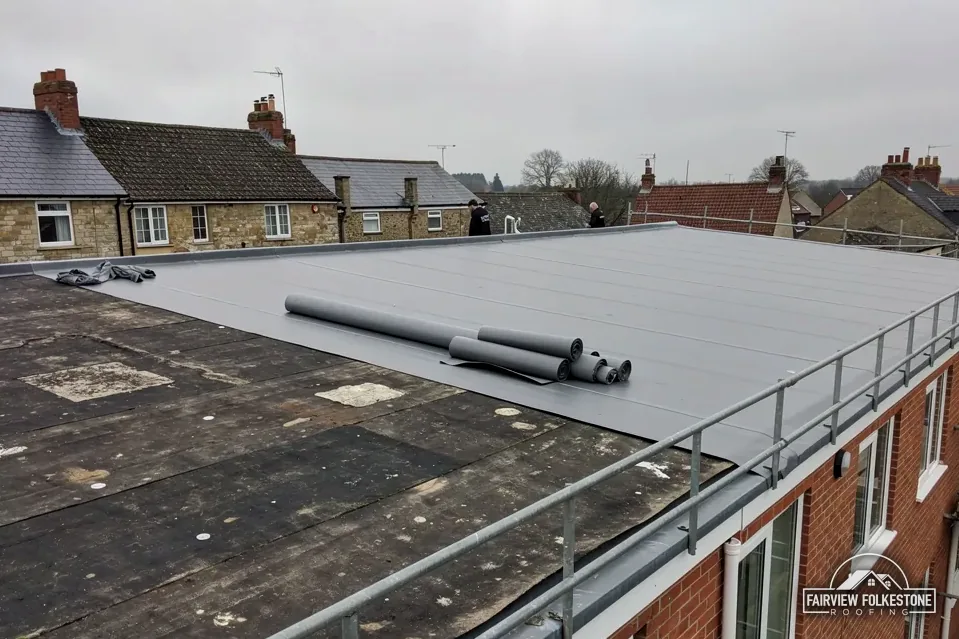
Where the Planning Portal draws the line
Two limits come from the Planning Portal's guidance on re-roofing. A re-roof stays outside the application route while it affects less than 25 per cent of the total building envelope, which counts every external surface from walls and floor to roof windows and rooflights, and less than 50 per cent of the roof itself. Pass either limit and expect to apply.
Apart from those limits, two triggers apply whatever the area.
- A replacement covering that gains 15 per cent or more in weight over the old one.
- A new covering that would behave significantly differently in a fire from the one it replaces.
The guide is written around houses, and a commercial roof is not a house. A single slope of a large shop, unit or office can pass 50 per cent of the roof by itself, so work that sounds like a repair may already sit over the line. No council near us sets a percentage of its own, which leaves the Portal's test as the published starting point, and building control as the body that confirms it for your building.
For an address in the Dover district a stricter council rule applies, set out in the last section below.
Weight, fire and energy on a larger roof
Three things can bring a commercial job under the Regulations whatever its size.
- Weight. Approved Document A, the structural guidance, calls any rise in roof loading above 15% a significant change. The Portal's advice is to put a structural engineer or surveyor on the question before work starts.
- Fire performance. If a new covering's behaviour in a fire is significantly different from the old one's, the Portal puts it on the approval list.
- Energy. Part L governs the energy side of a renewed roof. The tables in Approved Document L Volume 1 are written for dwellings, so we do not quote them for a commercial roof; building control confirms the standard that applies to yours.
Replacing a roof touches other rules as well. Asbestos cement sheets bring their own duties, covered in our answer on an asbestos cement roof.
Planning permission is a separate question from building control. Class C of the permitted development rules covers re-roofing a dwellinghouse, and a shop, unit or office is not one, so the local planning authority is the body to ask about the outward look of the building.
In practice the order is simple: confirm the covering and its weight, check how much of the roof the job touches, then ask building control whether an application is wanted.
Who to ask, by address
Building control is carried out by the council's building control team or by a registered building control approver, a private firm entered on the Building Safety Regulator's list. Councils divide the work by address, so the right team depends on where the building stands.
| Address | Who to ask |
|---|---|
| Folkestone, Hythe, New Romney | Folkestone & Hythe Building Control, 01303 853538 |
| Canterbury, Whitstable, Herne Bay | STG Building Control Partnership, 01634 331133 |
| Ashford, Tenterden | Ashford Borough Council Building Control, 01233 330282 |
| Rye, Camber | East Sussex Building Control Partnership, 01892 602005 |
Dover, Deal and Sandwich are different. Dover's own building control page names replacement roof coverings, even like for like, among the jobs that need approval, so on those streets the council is asked first, before any re-roof is planned.
Whichever body you use, it needs the specification before work starts: the covering, its weight, its fire classification and the build-up beneath it. We prepare those details at the survey stage, so an application, if one is needed, is not held up waiting for them.
Scaffold, plans and paperwork
Building control is one strand of the paperwork on a commercial job, and the others sit beside it.
Scaffolding that occupies the pavement is licensed by the highway authority for the county: Kent County Council for Kent addresses, East Sussex Highways in Rye and Camber. The written price includes the licence, which we arrange with our scaffolder.
Every project has a construction phase plan under CDM 2015. With several contractors on site, the principal contractor writes it and extra duties follow. Our answer on replacing a roof while the business stays open shows how that plan shapes the programme.
If the roof carries plant or a walkway, say so when you apply, because their supports and loads are part of the structure the council is checking. Keep what you are given: the building control decision or completion certificate, the asbestos survey result where there was one, and the written price. A buyer, a lender or a landlord may ask for them later. Our commercial roofing page lists the roof types this applies to.
More questions
Does fixing a leak on a commercial roof need approval?
A local repair normally does not. The Planning Portal test looks at how much of the envelope and the roof is affected, and a patch sits far below those limits. Changing the covering for a heavier one, or one that behaves differently in a fire, is a different matter and needs approval.
Who applies, the building owner or the roofer?
That is agreed before the job starts, and the application is made before any work begins. Ask the building control team how it wants the application made. We tell you at survey whether one is needed and which team to approach, then price the job knowing the route.
More on commercial roofing
All guides and posts
Tell us what's wrong with the roof.
You'll get one written total price.