
Working while open
Can a commercial roof be replaced while the business stays open?
A roof can be renewed in sections while staff and customers carry on below. Below: how phasing works, what you agree first, and when part of the building should close.
The short answer
Yes, if the roof is done in phases and the building is left weathertight at the end of each one. The roof is split into bays, and each is stripped, covered and closed before the next is opened. Noise, access, fall protection and the paperwork are agreed before the date is set. Some stages, such as lifting asbestos sheets, may need the area below cleared.
5 min read · Part of Commercial roofing
How phasing works on a live building
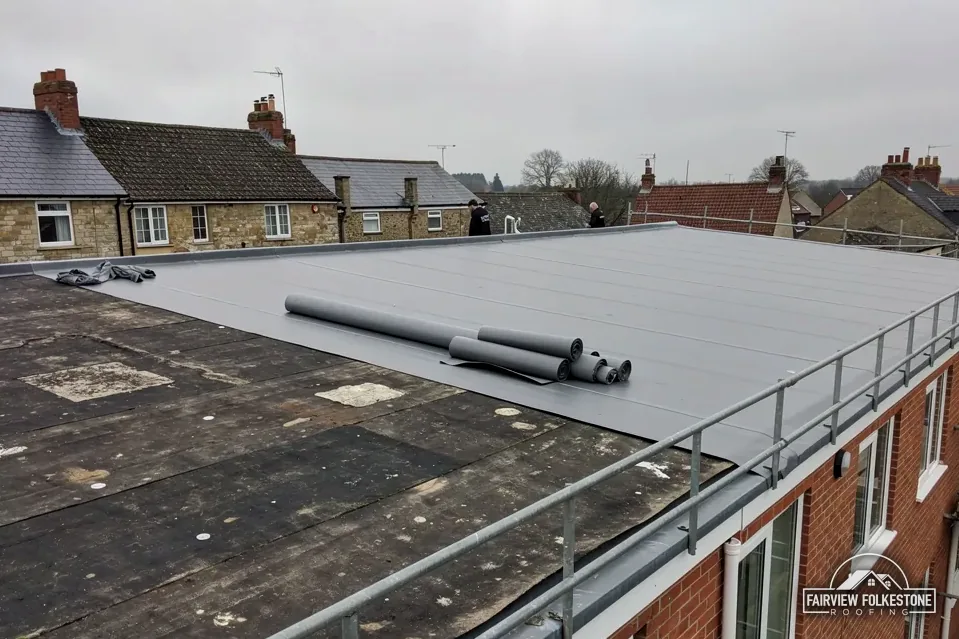
A roof is never opened all at once. It is divided into bays that can be stripped and closed within a single working period, and the order is set so that the part being worked on is always the part that can be made watertight by the end of the shift.
The sequence runs the same way on each bay.
- Mark out the bay and the area below it that needs protecting.
- Strip the covering and any defective insulation in that bay only.
- Lay the new build-up and weather the bay, using seals, a temporary cover or the finished covering, whichever the stage calls for.
- Check the bay and sign it off before the next one is started.
Drainage affects the order as well. Outlets and box gutters stay running throughout, so rain landing on a finished bay has somewhere to go. The weather decides each day's work, and an open bay is covered before rain arrives, never left in the hope of a dry spell.
We set the bay order with you at the survey, using the roof plan, so you know in advance which part of the building sits under the work on which days.
What you agree with us beforehand
Working over an occupied building needs agreements that an empty one does not.
- Hours of work, and which noisy tasks fall inside opening hours.
- Where the crew and materials enter, and how that route stays clear of customers and staff.
- Which areas below a bay are cleared, and for how long.
- Where the skip stands, and how deliveries and removals fit around your own.
- A named contact on your side for each day's work.
On a building with tenants or leaseholders, the agreement is wider, and a formal consultation can sit ahead of the work itself. Our guide on Section 20 roof works covers that.
If the scaffold has to stand across the footway, a licence is needed from the council that runs the roads, which means the county council in Kent and East Sussex Highways in Rye and Camber. We arrange the licence with our scaffolder, and the written price includes it, so the pavement work does not catch you out.
All of these points go into the written plan for the job, which you keep, so everyone on site works to the same sheet.
Safety for the people below and beside
When people stay in the building, the roof becomes a hazard to them as well as to the crew.
Under CDM 2015 each project needs a construction phase plan. Where several contractors share the site, the principal contractor draws it up and extra duties apply, while a single contractor writes its own. The plan covers the points that matter here: how the public and staff are kept away from the work, how falling debris is stopped, and what happens in an emergency.
Fragile surfaces add to it. On HSE's rating, an asbestos cement roof counts as fragile whatever its state, and skylights set in any sheet roof are approached with the same caution until they are inspected. Our page on fragile roofs and CDM duties covers what that means for the crew and for the owner.
Where the work involves asbestos, the area below may need to be cleared or closed while the sheets come off, because a sheet that breaks up becomes a different category of work. The survey tells you which stage that applies to, and we put it in the plan before the date is fixed.
When it is better to close part of the building
Phasing suits a roof that can be split into bays, but a few conditions make it better to move people out, or to close a bay or a room for a day.
- Asbestos sheets being removed over a working area.
- A strip down to the deck where the insulation is wet and the debris is heavy.
- Work over a space that cannot tolerate dust, noise or a drip, such as a food unit, a records room or a laboratory.
- A roof with no safe route for the crew that keeps clear of the public.
A short closure planned in advance is simpler than a long spell of working around people. We tell you which stages need one and, where we can, set them for the times when the building is quietest, such as a weekend or a planned shutdown. Agreeing those dates early also lets you tell your own customers, staff or tenants well ahead.
The written price covers the phasing you have agreed, and is one total. For the other roof types we cover, see our commercial roofing page, and for the building control side, our answer on commercial roof building regulations.
More questions
Will the roof be open to the weather while we trade?
Only for as long as a bay is being worked on, and it is closed again before the end of the shift. The bay order is planned so that rain cannot reach the floor, and the forecast is checked for each day's bay before it is opened, with a cover ready if the weather turns.
How loud is a re-roof over an occupied building?
Stripping and fixing are the noisy stages, and the noise depends on the covering and the method. We agree the working hours with you, move the loudest tasks to quieter periods where we can, and tell you in advance which days fall under which bay.
More on commercial roofing
All guides and posts
Tell us what's wrong with the roof.
You'll get one written total price.