
Flat roof lifespan
How long does a commercial flat roof last?
The covering sets the range, and the published sources disagree on it. Below: the published figures, what shortens a roof's life, and the signs that one is spent.
The short answer
It depends on the covering, and the published ranges disagree. HomeBuilding puts torch-on felt at 10 to 15 years and EPDM at 25 to 30. Less gives felt 10 to 20 years and says EPDM typically lasts 30 to 50. VMZinc states that zinc roofing, when correctly designed and installed, can last in excess of 100 years. Treat each as a guide and never as a promise about your building, so the survey decides.
4 min read · Part of Commercial roofing
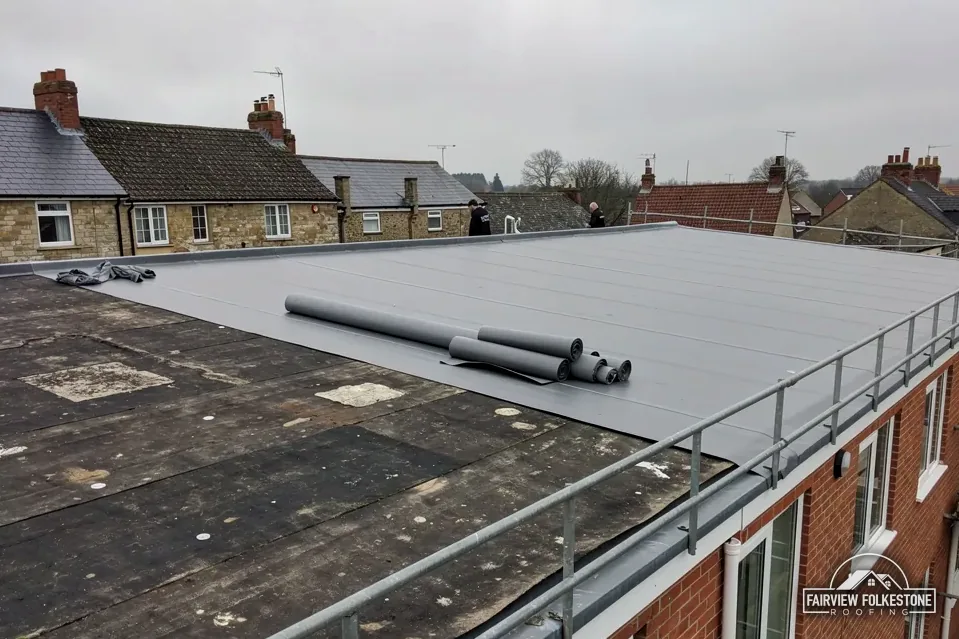
Published ranges for each covering
Two cost guides give lifespans for the main flat coverings, and they do not agree. HomeBuilding marks its figures as approximate, and its guide was last updated on 30 September 2025. Less was last updated on 27 October 2026. Both give ranges for the material, not for any particular commercial building, so read them as a starting point and nothing firmer. A commercial roof carries more plant, more foot traffic and bigger drainage runs than a garage or an extension, and each of those can pull the real figure either way.
| Covering | HomeBuilding | Less |
|---|---|---|
| Torch-on felt | 10 to 15 | 10 to 20 |
| GRP | 25 to 30 | 25 to 40 |
| EPDM | 25 to 30 | 30 to 50 |
| Lead | 60 to 100 | 50 to 100 |
Less qualifies its felt figure with quality and installation, and says GRP fibreglass lasts 25 to 40 years with minimal maintenance. Zinc comes from its maker: VMZinc adds that the BRE Environmental Product Declaration states 100 years for it. Lead heads both lists, though the two guides differ on where its range starts, with 60 years as the low end in one and 50 in the other.
Why one roof falls short of its range
A range describes a covering that was laid well and looked after. Four things pull a real roof below it.
- Falls. Under BS 6229:2025, the NFRC reports, the finished fall on a membrane roof should be no less than 1:80. Water that lies on the surface ages a covering faster than water that clears.
- Outlets and box gutters that block, so water rises over the lining and spills inward.
- Foot traffic and plant. Cooling units, walkways and maintenance visits load the membrane around their supports.
- Details at upstands, drip trims and penetrations, which give way before the open field of the roof does.
BS 6229:2018 is withdrawn, and the current edition is the 2025 one, written for continuously supported flexible waterproof coverings. A roof laid to the older edition may still be sound, but when you plan the next layer its falls are worth measuring against the new minimum, because a repair that ignores them leaves the cause in place.
Our answer on single-ply membrane roofing describes how the seams and fixings on that kind of roof age.
Signs the covering has run its course
A lifespan figure tells you when to start looking, not when to act. What triggers action is what a survey finds on the roof and inside the building below it.
- Seams lifting across the whole roof rather than at a single lap.
- Blisters in felt, or a membrane gone hard and cracked at the folds.
- Insulation found wet when it is tested, or ceiling stains that come back after each patch.
- Ponding that is still there days after rain.
- Repairs that have to be repeated at the same detail.
One of these on an otherwise healthy roof calls for a repair, and a repair is what we recommend. Several together, with wet insulation under them, describe a roof that now costs more in patches than a new covering would. We tell you which one yours is, and show you the wet areas and the photographs from the survey.
Wet insulation carries extra weight because a new layer cannot dry it out from above. A covering laid across damp material seals the moisture in, so the survey looks for it before any recover is considered.
What we do with the answer
A repair stays the right answer where the roof is otherwise healthy and the trouble is confined to one spot. A replacement becomes the answer when the covering is past mending or the insulation has gone. Our guide to refurbishing or replacing a commercial roof explains how that choice is made.
The survey records the covering, its age if you know it, the falls and the condition of every detail. We then write you a view of the roof. If replacement is the answer, you receive one written total price, with scaffold or access included, instead of a lifespan guess.
For the wider list of roof types we cover, see commercial roofing.
Keep the records, and ask for a copy of each survey you commission. A dated survey, photographs and a note of every repair show the next owner, lender or surveyor how the roof has aged. They also make the next lifespan estimate far less of a guess, because they show how this roof behaved in practice and not how a material is said to behave on paper.
More questions
Does a longer lifespan figure mean a better roof?
Not by itself. Lead and zinc carry the longest published figures, but a membrane that is detailed well and drains properly can outlast a longer-lived material that is badly laid. The covering sets the range, and the build decides where in that range your roof ends up.
Can a patched commercial roof still reach its lifespan?
Yes, where the faults are local and the insulation beneath is dry. Patching a seam or an upstand is sound repair on a roof like that. Patching a roof with wet insulation and lifting seams everywhere only delays the leak, and a survey tells the two situations apart.
More on commercial roofing
All guides and posts
Tell us what's wrong with the roof.
You'll get one written total price.