
Single-ply membrane
What is single-ply membrane roofing?
Single-ply is a factory-made sheet laid across a flat roof in one layer. Below: how the systems differ, how they are fixed and joined, and what the standard says.
The short answer
Single-ply roofing is a flat roof covering made from one factory-made sheet of synthetic material, such as PVC, TPO or EPDM rubber, laid over the insulation. The sheets are joined at the seams by heat welding, adhesive or tape, and held to the roof by fixings, adhesive or ballast. It is one of several flat coverings, alongside felt, GRP and metal.
5 min read · Part of Commercial roofing
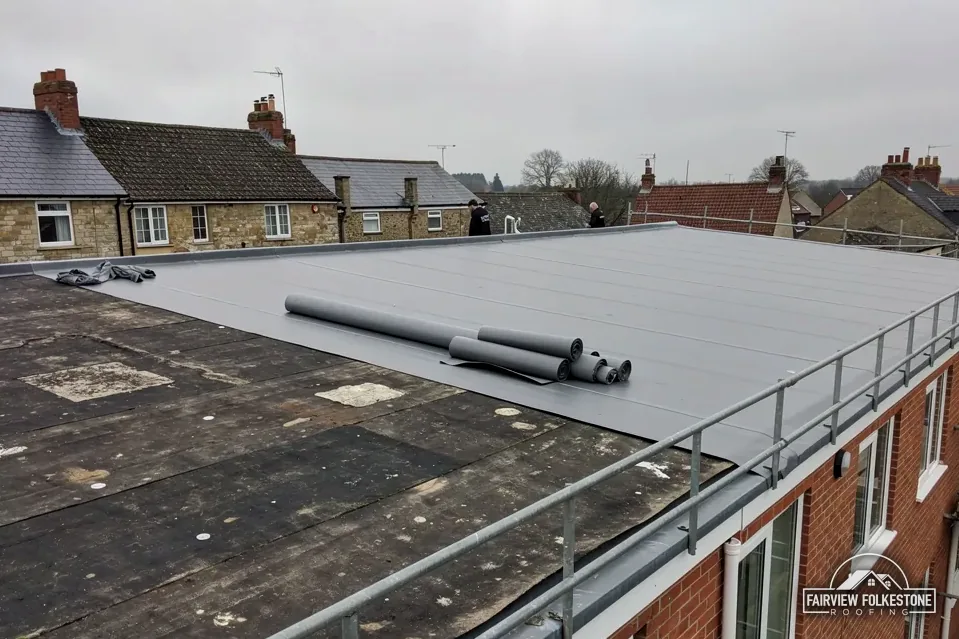
What goes into a single-ply roof
The name describes the waterproof layer, not the whole roof. Beneath the sheet sits the build-up that makes the roof work.
- The deck: timber, metal or concrete, which carries the load.
- A vapour layer in some designs, which slows damp air from rising into the insulation.
- Insulation, often rigid boards, laid to give the roof its falls where they are needed.
- The single-ply sheet itself, running across the roof in wide widths.
- Edge trims, upstands and flashings, where the sheet turns up a wall or off the edge.
Three materials are common. PVC and TPO are thermoplastic sheets that can be welded with hot air at the seams, which fuses two sheets into one. EPDM is a synthetic rubber that arrives in large pieces and is joined with adhesive or tape, so there is no welding at its seams. Each has its own makers' systems, and an installer is approved for some and not others, so the system is named in the specification. The thickness of the sheet is named there too, along with the make of the insulation boards, because the sheet and the boards are designed to work as a pair.
Our answer on commercial flat roof lifespan compares the published figures for these coverings.
How the sheet is held down
A single-ply sheet needs something to stop the wind lifting it, and there are three ways to supply it.
| Method | How it works |
|---|---|
| Mechanically fixed | Fasteners through the sheet laps into the deck |
| Adhered | Bonded across the whole surface to the insulation |
| Ballasted | Held by a layer of stone or paving on top |
The right choice depends on the deck, the load the structure can take and the exposure of the site. A ballasted roof adds weight, so the structure has to carry it, and the Planning Portal puts a new covering 15 per cent or more heavier on the list of work that needs Building Regulations approval. Our answer on commercial roof building regulations explains that test.
Wind uplift is calculated for the site, so the number and spacing of fixings are set by the system maker's design and not by habit. On a coastal or hilltop building, that calculation is where the site's exposure counts.
Fixing details are checked at the survey on an existing roof. Where fixings have started to lift, or the sheet flaps in the wind, that is a fault to correct before anything else is laid.
Seams, falls and the standard
The seams are the working part of the system. A welded seam makes two sheets one piece, and a taped or glued one relies on the bond holding. On a survey, the seams are probed along their length for lifting, and any that move or open are marked on the roof plan.
Falls matter to single-ply as much as to any other flat covering. The current standard, BS 6229:2025, is the code of practice for flat roofs whose waterproof layer is flexible and fully supported, and the NFRC reports that it sets 1:80 as the minimum finished fall. BS 6229:2018 has been withdrawn.
Ponding is the sign that falls have fallen short. A roof that holds water around an outlet, or in a dip across the deck, keeps water sitting on the sheet at that spot, and a new sheet laid over the same deck holds the same pools. The remedy is tapered insulation or firrings, which add slope under the new sheet.
Details matter as well. Upstands, penetrations and drip trims are where the sheet changes direction, and where the maker's welded or sealed details do the work.
Single-ply compared with the alternatives
Single-ply is one choice among several, and the survey says whether it suits your building.
Felt is bitumen-based and laid in two or three layers, bonded or torched on. GRP is a glass fibre laminate that is laid in resin on a timber deck and left to harden. Metal, such as lead or zinc, is a different kind of roof altogether, with its own lifespans and details. Published figures put EPDM at 25 to 30 years (HomeBuilding) and 30 to 50 years (Less), which shows how far sources can differ, and neither is a promise for a specific roof.
Single-ply suits large, plain roofs, where wide sheets cover the area with few joints, but the deck, the plant on the roof and the access decide whether it is the right system. A roof with many penetrations, or one that people walk on, calls for a harder look at the details and the walkways.
We survey the roof, then tell you which covering we would fit and why, followed by one written total price. See our commercial roofing page for the roofs we cover.
More questions
Is single-ply the same as a rubber roof?
Only when the sheet is EPDM, which is a synthetic rubber. Single-ply also covers PVC and TPO sheets, which are thermoplastics welded at the seams. All of them are one waterproof layer laid over insulation, and the survey and the specification name which one your roof gets.
Can a single-ply sheet be laid over the old covering?
Where the old covering, the insulation and the deck are all dry and the falls shed water, a recover can work. The survey checks that before anything else. Wet insulation changes the answer, because a sheet put down over wet insulation shuts the moisture in, and that roof is stripped to the deck instead.
More on commercial roofing
All guides and posts
Tell us what's wrong with the roof.
You'll get one written total price.