
Asbestos sheets
What should you do about an asbestos cement roof on a commercial building?
An asbestos cement roof needs a survey and careful handling before any repair. Below: the HSE categories, the waste route and the order of work.
The short answer
Treat the roof as asbestos, and as fragile, until a survey proves otherwise. HSE tells owners to presume asbestos in a building built or refurbished before 2000, and its guidance A14 calls asbestos cement roofs always fragile. Cement sheets taken off whole are non-licensed work, while sheets that have broken up fall into a stricter category. We survey first, then give you one written total price.
4 min read · Part of Commercial roofing
Confirming what the sheets are
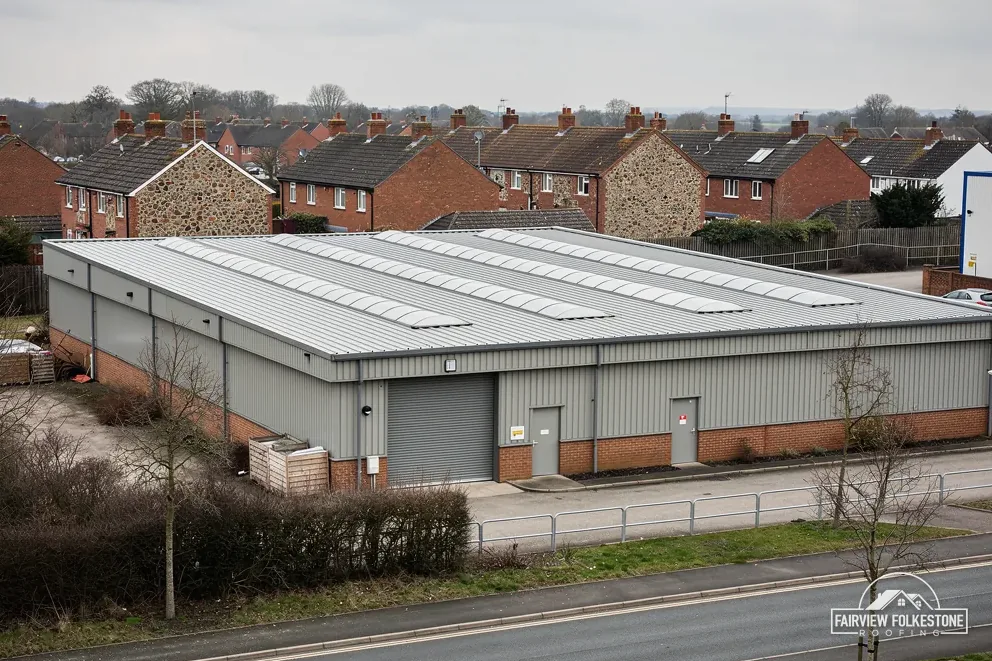
Seen from the ground, cement sheets look much like any other profiled sheet, so the age of the building is the first clue. HSE's wording is that a building built or refurbished before 2000 should be presumed to contain asbestos. A unit, workshop or warehouse of that vintage with a sheeted roof sits inside the advice, and so does a newer building whose roof was refurbished in the 1990s.
Where the sheets cannot be dated, a sampled asbestos survey settles the matter. Until a laboratory result is back, the sheets are handled as asbestos, and nobody walks over them for a closer look. The report records what was proven and what was only presumed, so a later owner can see the basis for each decision.
Condition counts as much as material. HSE's A14 guidance describes asbestos cement roofs as always fragile, however sound they appear from above. A sheet that held someone's weight last month can give way this month. Every job on or beside such a roof therefore begins with crawling boards, a working platform or edge protection, put up from a safe point of access before anyone steps onto the slope. Our page on fragile roofs and CDM duties sets out who carries which duty.
Which HSE category the work falls into
HSE sorts asbestos work by what the material is and what state it has reached. The category decides who may carry out the job and whether it must be notified. Three categories meet on a commercial roof.
| What is being handled | HSE category |
|---|---|
| Cement sheets, weathered but not otherwise substantially damaged, lifted carefully without breaking up | Non-licensed |
| Cement sheets already cracked, broken up or substantially damaged, as after a fire or a flood | Notifiable non-licensed work (NNLW) |
| Asbestos insulating board (AIB), such as soffit panels under the eaves | Most work is licensed |
HSE's list of locations names white AIB soffit panels at the eaves, so a roofing job can reach AIB even when the roof sheets are cement. Licensed work belongs to a contractor who holds the licence. The survey shows whether any part of your building falls in that group, and the answer comes before any price does. Where sheets have already cracked, the category can change in the middle of a job, so the plan names who stops work, and who is told, before the first fixing is touched.
Skips, carriers and paperwork
Cement sheeting becomes hazardous waste the moment it leaves the roof, and it carries rules of its own.
- HSE advises a lockable skip for asbestos, and says that sheeting thrown over a standard skip does not meet that advice.
- The household exemption from consignment notes covers hazardous waste other than asbestos waste, so asbestos travels with its paperwork.
- Ask any carrier to show you its waste carrier registration before the skip arrives, and keep a copy of it with the consignment note for the load.
Asbestos from a roofing job counts as trade waste, which travels under a consignment note. Kent County Council's household waste recycling centres do accept asbestos, but only from residents, in small double-wrapped loads, with a declaration that it came from the resident's own home. A business clearing its roof cannot use that route.
A lockable skip needs room, so on a site with tight access we fix its position at the survey stage, before a start date is set. Delivery and collection times are fitted around your own deliveries too.
The order of work and the price
Once the sheets are identified, the sequence follows from what the survey found.
- Survey the roof, presuming asbestos until sampling says otherwise.
- Agree the category of work and, if it is notifiable or licensed, who carries it out.
- Set up fall protection, boards and the lockable skip.
- Release the fixings and lift sound sheets whole, rather than breaking them.
- Lay the new covering and close the building to the weather.
You receive that sequence in writing at the start, so the order of work is clear before anyone is on site.
The Construction (Design and Management) Regulations 2015 govern all of this. Where several contractors share the project, the principal contractor writes the construction phase plan, and where there is a single contractor it writes its own. A plan exists before the first sheet moves. A replacement roof also brings the Building Regulations into play, which our answer on commercial roof building regulations explains.
The figure follows the survey rather than a rate card, because the sheets, the access and the waste route all change the work. Our commercial roofing page lists the other roof types we survey.
More questions
Can an asbestos cement roof stay in place and be left alone?
Sometimes, where the sheets are sound and nothing is disturbing them. The roof still needs a survey to record its condition, and it stays fragile, so nobody should walk on it. Any repair, drilling or work beside it is planned first, and damaged sheets move into a stricter HSE category.
Who decides whether the roof sheets are asbestos?
A sampled asbestos survey decides it, not a visual guess. HSE tells owners to presume asbestos in a building built or refurbished before 2000, so the sheets are handled as asbestos until the laboratory result comes back. We note what we see at the roof survey, and the result settles what the sheets are.
Tell us what's wrong with the roof.
You'll get one written total price.