
Flat roof regulations
Does a new flat roof need building regulations approval?
Planning permission and Building Regulations are separate tests. Below: the Portal test, what Part L adds, who signs the work off, and where planning fits.
The short answer
For a small repair, no; for a whole new membrane, Part L comes in, and the Planning Portal's re-roofing test says whether an application is needed. The size limits are under 25 per cent of the building envelope and under 50 per cent of the roof, while a covering heavier by 15 per cent or more needs approval at any area. In the Dover district the council's own rule is stricter. Listed homes, flats and Article 4 areas have separate planning rules.
5 min read · Part of Flat roofing
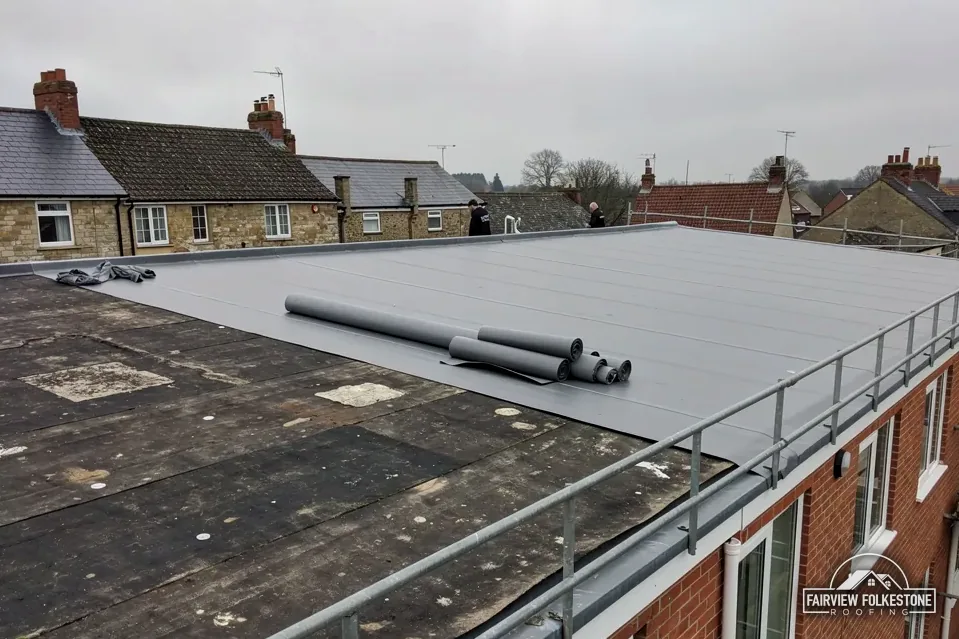
The Portal test applied to a flat roof
The Planning Portal publishes a re-roofing test with four parts, and any one of them can bring in an application. Read the sizes first. The work must touch less than 25 per cent of the building envelope, that is, every external surface of the building, and less than 50 per cent of the roof. A flat roof over a rear extension can be a large share of a small house's roof, so a new membrane there may cross the limit without anyone noticing.
- size against the envelope: under 25 per cent
- size against the roof: under 50 per cent
- weight: a new covering 15 per cent or more heavier needs approval
- fire: a covering whose fire performance would differ significantly from the old one needs approval too
None of the councils around us gives a percentage figure of its own. Folkestone & Hythe District Council's guidance mentions roof coverings as something you may need approval for, and in the same breath says most repairs, replacements and maintenance work is exempt. Both thresholds are tested against what is actually renovated, so a half-roof job and a whole-roof job can get different answers. Where the answer is close, ask the council before the date is fixed, not after.
What Part L adds to a new membrane
Part L is the energy half of the regulations. In England the guide is Approved Document L, 2021 edition, and para 11.2(d) puts a replaced flat-roof waterproof layer in the renovation category. Para 11.3 sets the trigger: more than 50% of the surface of the roof renovated, or a major renovation, which is more than 25% of the external envelope area. Past either line, the whole roof should be improved to the figure in column (b) of Table 4.3.
- The improved figure is 0.16 W/m²K, and the threshold beside it is 0.35 W/m²K.
- If that cannot be reached, or would take longer than 15 years to repay, para 4.13 asks for the best value that can, and generally no worse than 0.7.
- A rooflight set in the finished roof carries a separate limit of 2.2 W/m²K in Table 4.2.
- The 2026 edition of the guide applies from 24 March 2027, with its tables renumbered 3.2 and 3.3.
So a full flat re-roof is when the insulation is best brought up to standard, and the written quote shows what goes in. Where the figure cannot be met, the quote records why, and the lowest feasible value is what goes in.
Who signs the work off
Building control is carried out by the council's building control team or by a registered building control approver, a firm that must be registered with the Building Safety Regulator. If you ask the council, the team depends on the address:
- Folkestone, Hythe and New Romney addresses go to Folkestone & Hythe Building Control, on 01303 853538.
- Dover, Deal and Sandwich addresses go to Dover District Council, whose building control page names "replacement of roof coverings on pitched and flat roofs even if this is just like for like" as work needing approval. We therefore ask the council before the old roof comes off.
- Canterbury, Whitstable and Herne Bay use the STG Building Control Partnership, on 01634 331133.
- Ashford and Tenterden have Ashford Borough Council Building Control, on 01233 330282.
- Rye and Camber use the East Sussex Building Control Partnership, on 01892 602005.
Ask before work starts, with the survey notes to hand. Agreeing the route first is far easier than putting it right afterwards, and photographs of the old roof make the conversation quicker.
Planning permission is a separate question
Planning is its own test, and a building regulations answer never settles it. Class C of the permitted development rules is the one for re-roofing, and for a house it normally allows a change of covering without an application. Three things alter that:
- a flat or maisonette has no permitted development rights, and Canterbury City Council says its owner needs planning permission to change the outside appearance
- a listed home retains the rights, but any work touching its character needs listed building consent
- an Article 4 direction can withdraw rights across a defined area, so a council's map is worth checking
The reverse also holds: planning permission, where it is needed, does not stand in for building control. None of this changes with the covering, because EPDM, GRP and felt are treated alike. The questions turn on the house and its location, not on the product on the roof.
Our flat roof cost answer covers how the written price is set, and the flat roofing page sets out how the survey becomes a verdict.
More questions
Does a rooflight in a new flat roof change the answer?
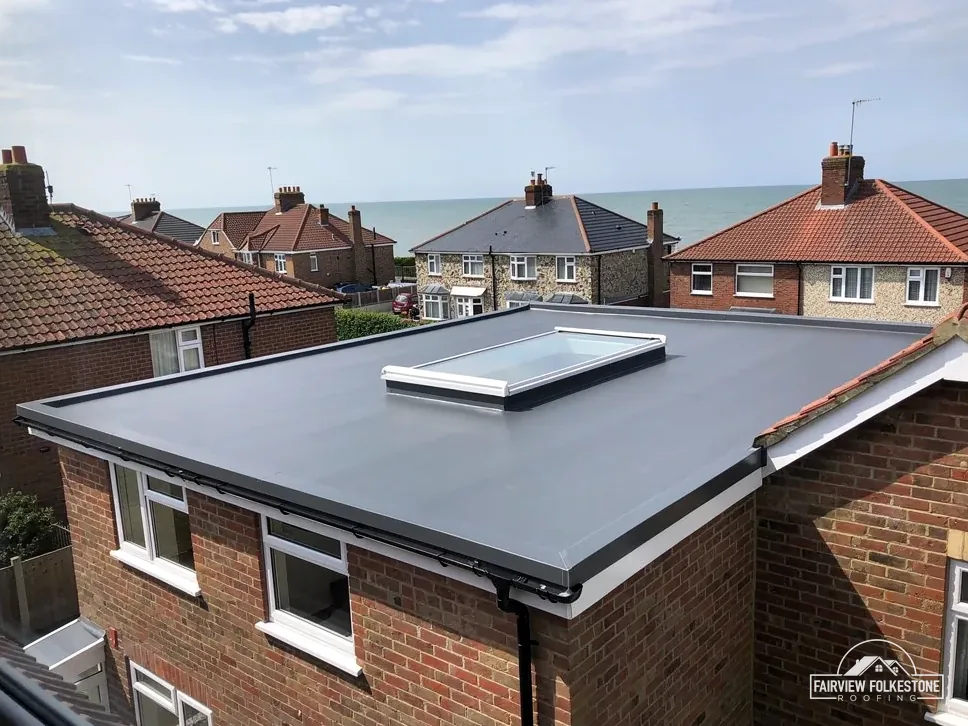
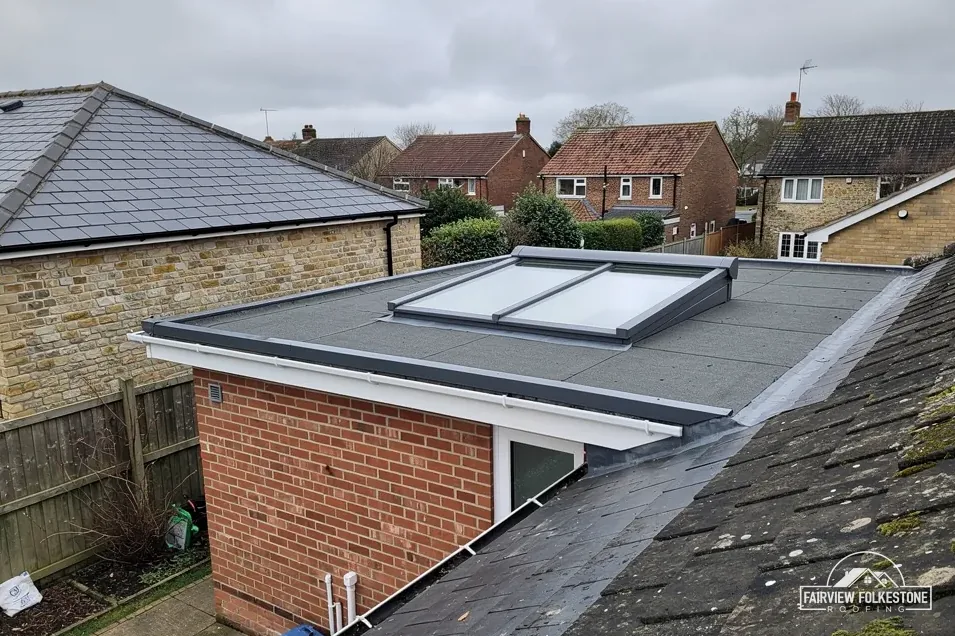
It brings a rule of its own. Table 4.2 of Approved Document L 2021 asks 2.2 W/m²K of a new rooflight, and the Planning Portal counts rooflights as part of the building envelope in its test of less than 25 per cent. We check the route for a rooflight with building control, along with the membrane, before any date is fixed.
Does fixing a leak on a flat roof need an application?
Not in the normal case. Folkestone & Hythe District Council points out that most repairs and maintenance need no approval, and mending a split on a sound roof is work of that kind. A new membrane across the whole roof is a bigger step, and that is where the Portal test and Part L come in.
Tell us what's wrong with the roof.
You'll get one written total price.