
Ridge repointing
Can ridge tiles be repointed, or do they need rebedding?
Repointing only works while the bed under the ridge tiles is still bonded. Below: how to tell, what rebedding adds, the time each job takes and the rules.
The short answer
Ridge tiles can be repointed only when the mortar bed under them is still hard and the tiles are bonded to it. If the bed has crumbled or a tile rocks when pressed, the tiles need lifting and rebedding with mechanical fixings. Repointing is a surface repair to the joint, so it cannot hold a loose tile down, and since the 2015 changes to BS 5534 mortar alone is no longer relied on to secure ridge tiles.
4 min read · Part of Pitched roofing

Where repointing is enough
Repointing means raking out the loose, weathered mortar from the joints at the ends and edges of each ridge tile and filling them again with fresh mortar. It suits a ridge whose tiles are still firmly bedded and whose only fault is a worn joint. The check has to be made on the roof itself: each tile is pressed, watched for any rocking, and the bedding underneath is sounded by hand.
Repointing is worth considering when all of these hold:
- every tile sits solid when pressed along the ridge
- the bedding under the tiles is hard and intact, with the cracks confined to the visible joint
- no tile is chipped, split or slipped out of line
- the ridge already carries mechanical fixings, so the mortar is only a weather seal
If all four are true, a repoint is the right repair and a full rebed would be money spent for nothing. We also look along the line of the ridge from the ground, because a sag or a step in that line points to movement that fresh mortar will not cure.
When the bedding has to come off
A tile that rocks, a bed that has crumbled to sand or a joint that has dropped out in lumps all point the same way. Fresh mortar pressed into the joint seals the surface and does nothing for the bond underneath. Marley, the tile maker, says mortar has long been the popular method at ridges, hips and verges, but that several factors can cause it to fail, often within the first few years of a roof being finished.
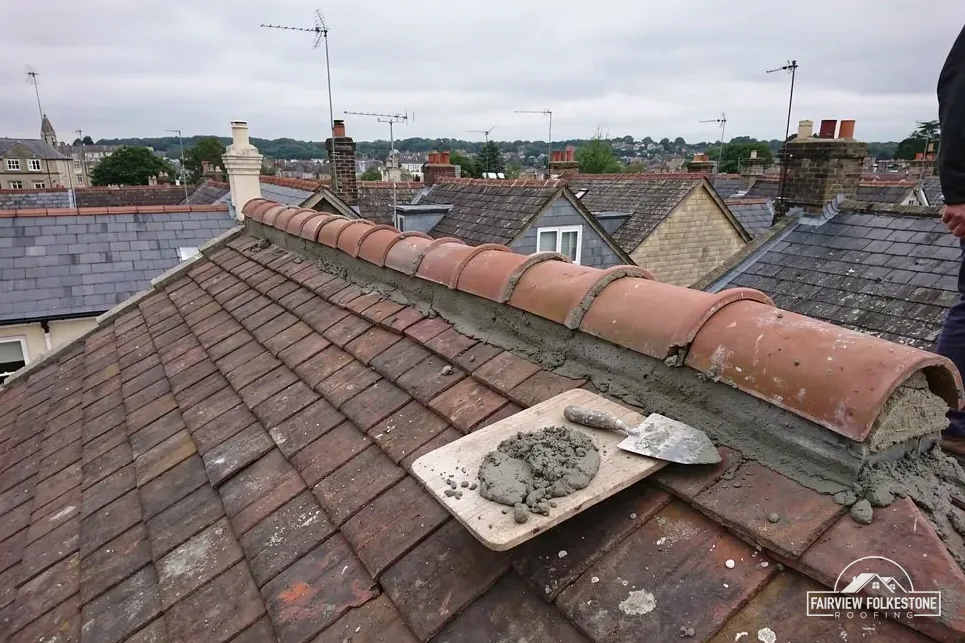
BS 5534 is guidance rather than legislation. Marley reports that its 2015 amendments ended the idea of mortar being the sole fixing for the covering: ridge and hip tiles had to be mechanically fixed whether or not mortar is used. Rebedding therefore means:
- lifting the ridge tiles and clearing out the old bed
- laying a fresh bed of mortar along the ridge
- setting the tiles into it and fixing each with screws, nails or clips
- pointing the joints for a clean finish
MyJobQuote describes the same sequence, and adds that some jobs skip the mortar and fix the tiles mechanically alone. Our page on dry ridge or mortar bedding compares those two routes.
How long each ridge job takes
These are MyJobQuote's published timescales for ridge work. A roof with awkward access, or one where more tiles turn out to be damaged once the old mortar comes away, will take longer than the table suggests, and a wet or frosty morning can push the work to another day because fresh mortar needs dry conditions to cure.
| Job | Timescale |
|---|---|
| Repointing ridge tiles, per 10 m | 2 to 4 hours |
| Repairing 1 to 3 ridge tiles | About 2 hours |
| Repairing 4 to 6 ridge tiles | About 4 hours |
| Full ridge, semi-detached, 8 to 10 m | 6 to 8 hours |
A repoint is quick, but the ridge is also the line where two slopes meet, so the survey looks at more than the mortar. The finishing tiles at each end of the run, by a gable or a hip, get as much attention as the middle. Mortar lying in the gutter, daylight visible along the ridge from the loft, or a tile that has shifted along the line all justify a closer look, and the page on tiles blowing off in wind explains how those faults start.
What it costs and which rules apply
Third-party cost guides give a picture, never a quote. Which? gives £80 to £300 for fitting a new ridge tile, from Trusted Traders surveyed in November 2025 and excluding VAT, and warns that South East jobs are likely to land towards the top of that range. MyJobQuote gives an average ridge tile replacement of between £225 and £550 in 2026. Checkatrade lists ridge tile repairs at £50 to £70 per metre.
Whether a ridge needs a repoint, a rebed or a few replacement tiles is settled on the roof, and the price we send after the survey covers the whole job as one written total.
A ridge repair sits far inside the Planning Portal's re-roofing test, which looks at less than 25 per cent of the building envelope and less than 50 per cent of the roof, so a building regulations application is not normally needed. A short ridge job also leaves the loft and the rafters alone. A listed home is different: listed building consent applies where work would change its special character, so ask the council before touching the ridge. Our pitched roofing page sets out how the wider work runs.
More questions
How can I tell whether the bedding under a ridge tile is sound?
A roofer presses each tile to feel for movement, looks along the ridge for steps or sags, and checks whether the mortar crumbles to sand or sounds hollow. From the ground you can only see missing mortar and tiles out of line, so leave the climbing to a roofer who has the right access.
Does repointing a ridge need building regulations approval?
Not on its own. A ridge repair sits well inside the Planning Portal's test of less than 25 per cent of the building envelope and less than 50 per cent of the roof. A listed home is different, because listed building consent applies where work changes its character, so check with the council first.

Tell us what's wrong with the roof.
You'll get one written total price.