
Flat roofs
Is spray foam under a flat roof a problem?
The deck is the board layer under the waterproof covering, and foam sprayed beneath it hides the timber. Below: why that matters and what to check.
The short answer
It can be, because foam sprayed directly under a flat roof deck partly seals the timber and hides it from view. The Energy Saving Trust notes that closed-cell foam passes no vapour. With open-cell foam it says the danger should be much lower, though not nil. Whether yours is a problem depends on moisture readings from the timber and on how the roof was built.
4 min read · Part of Spray foam removal
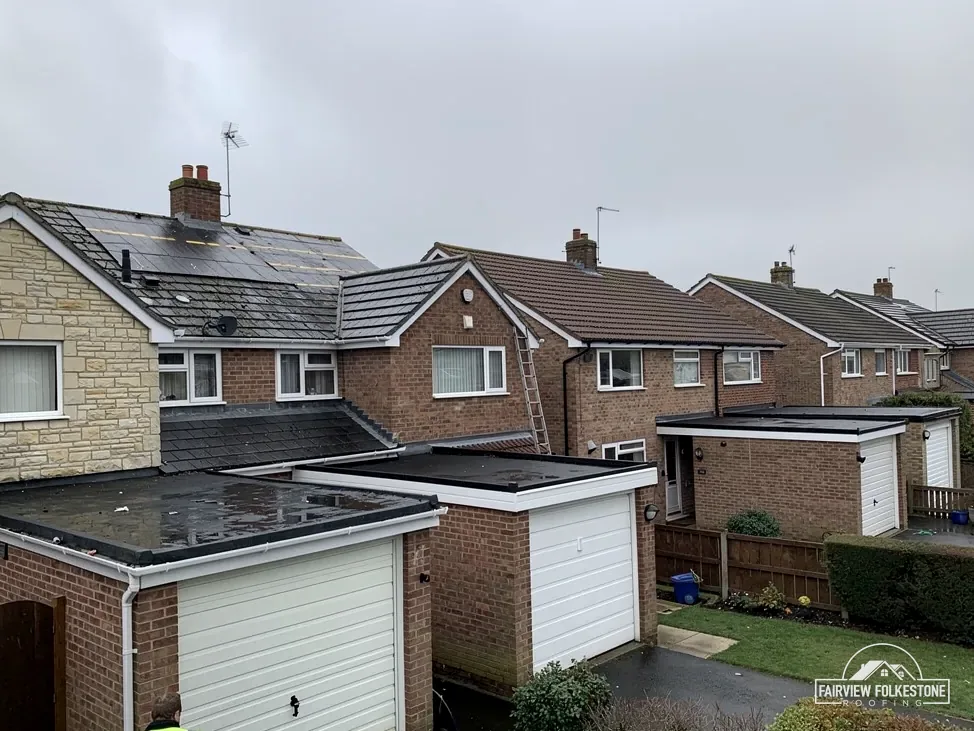
What foam under a deck changes
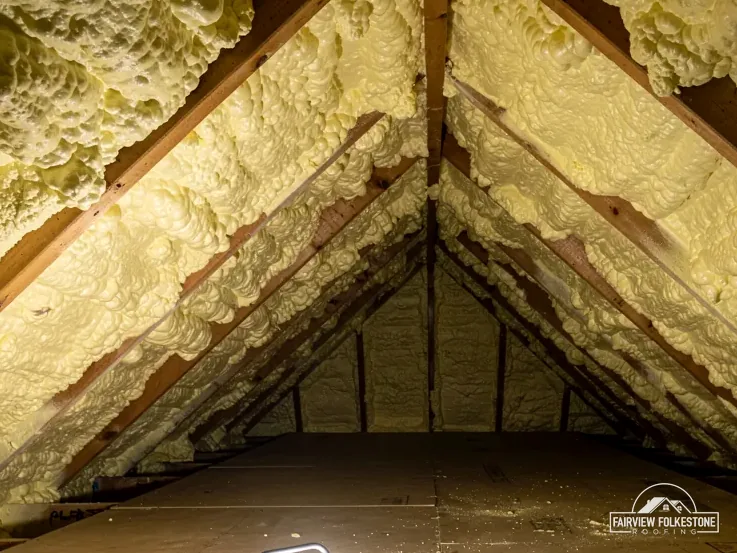
A flat roof has a waterproof layer on top, a deck of boards beneath it and joists below that. Spray foam goes on the underside of the deck, between and across the joists, and from then on the timber is out of sight.
The Energy Saving Trust makes two points that matter here. Foam applied straight onto the roof underside partly seals the timber, so any water that collects has fewer routes out. The closed-cell type lets no vapour through, while with open-cell foam the danger should be much lower, though not nil.
RICS adds that a covered roof timber stops being fully visible for inspection. For a flat roof that matters more than usual, since the first sign of a failing membrane is often a stain or soft patch on the underside of the deck, and foam covers exactly that place. A leak can therefore run for a long time before anything shows below, and by then the damage may be well advanced. Timber that has stayed wet for long enough softens, and a soft joist cannot be left under a membrane.
Falls, ponding and where leaks go
A flat roof is not meant to be flat. For membrane roofs, NFRC reports a 1:80 minimum finished fall in BS 6229:2025, and IKO adds that, to get there, the roof should be designed for a 1:40 fall. The designer aims steeper so that building tolerances do not leave pools, and a roof laid short of its fall is a fault to correct at the membrane stage, not something foam below can disguise or cure.
A roof short of its fall holds water in shallow pools, and a membrane under standing water has more chance of letting some through. Where there is foam beneath, that water meets timber that cannot be looked at, and it may spread along the deck before it shows. A survey therefore looks at the surface above and the underside below together: pools and blistering on the membrane, then the foam for staining, gaps or damp edges.
The BSI scope for that standard is membrane roofs, so a lead roof is outside it. Which covering is on yours changes how it is repaired, but not the need to see the deck.
Checking a foamed flat roof
The checks are simple, and each tells you something different.
| Check | What it tells you |
|---|---|
| Moisture meter on joists | Whether timber is wet |
| Probe at the ends | Whether wood is soft |
| Test area in the foam | What the deck looks like |
| Membrane survey above | Splits, pools, laps |
Readings at the joist ends and the edges are the most telling, because those are the places a leak is most likely to reach, and a spread of damp patches across several joists points to a wider fault. Edge and joist ends can be reached only where the foam is cut back, so the test area is placed where a failure would be most revealing and least costly to repair. If the readings are dry and the timber firm, the foam may be left in place with a note on what to watch. If they are not, the foam comes out of the affected area so the timber can be dealt with. Our flat roofing service covers the membrane work.
When the membrane is being renewed
A new membrane is the time to settle the question for good, because the deck is exposed anyway. AD L 2021 para 11.2(d) names a new waterproof membrane for a flat roof as renovation, and para 11.3 says that once more than 50% of the surface of the individual thermal element is renovated, the whole element should be improved. Table 4.3 puts the improved roof value at 0.16 W/m²K, with 0.35 as the threshold.
In practice, foam that stays under a renewed membrane is judged as part of the roof's insulation, and foam that comes out has to be replaced by something that meets the same figure. The Planning Portal's test for re-roofing is a separate matter, and a roof of this kind may still need building control approval, so ask first and keep the council's reply. Whoever fits the membrane should also leave the deck edges and the upstands in a state that lets them be inspected later, with the old foam either cleared or recorded.
Our answer on spray foam and condensation explains how the timber dries, and the spray foam removal page sets out the survey that comes first.
More questions
Is open-cell foam safe under a flat roof?
With an open-cell foam the Energy Saving Trust says the danger should be much lower, which is different from safe. The deck is still covered, the timber still cannot be seen, and a leak can still run unnoticed. Readings from the joists settle the question, and the answer is written down after the survey.
Can foam under a flat roof stay if the membrane is replaced?
It can where the readings are dry and the timber is firm, but the new membrane and the foam are then judged as one roof for the energy rules. If the timber is wet or soft, the affected foam comes out first. Which of the two applies is a finding of the survey, not a guess.


Tell us what's wrong with the roof.
You'll get one written total price.