
Shared stacks
Who pays to repair a chimney stack shared with a neighbour?
A stack over two homes needs a conversation as much as a repair. Here is what the Party Wall Act covers, and how two owners can settle a bill.
The short answer
It depends on who needs the work and why, so no single split fits every stack. The Party Wall etc. Act 1996 sets steps for notices and disputes, not a fixed share of the bill. Agree the plan with your neighbour in writing first, and ask for a single written price covering the entire job, so the cost can be divided fairly.
5 min read · Part of Chimney repairs
When a notice is needed
Whether a notice is needed turns on the work and on how the stack is built, not on who owns the roof tiles. The Act hands a building owner some rights that bear on chimneys, and each comes with duties.
- Section 2(2)(g) covers cutting away a breast, jamb or flue that projects from a party wall.
- Section 2(2)(j) covers cutting into the neighbour's building to fit flashing or other weather-proofing for a wall built against it.
- Section 3 requires the party structure notice to be served at least two months before the proposed work starts.
The building owner is the one who serves it. If the neighbour has not consented within 14 days, the Act treats them as having dissented, and a dispute follows: the two sides appoint one agreed surveyor, or one each. Written consent from the neighbour lets the work start sooner. GOV.UK warns that silence cannot be read as agreement.
Questions about notices go to a party wall surveyor, not to building control. Our chimney breast removal page follows the same steps for work done inside the house.
Working it out with the neighbour
Surprise is what sours a shared repair. A calm word before the survey, and a shared set of facts afterwards, takes the sting out of it.
- Tell your neighbour what you have seen, with a photograph, before anyone goes on the roof.
- Ask whether they will let the surveyor into their loft, since a stack shows different faults from each side.
- Share the survey findings with them, including which items help both homes.
- Settle the split on paper before a start date is booked.
- Give them the start date, and warn them about the scaffold.
If one side wants work the other does not, the notice route in the Act exists for exactly that case. Keep the tone practical: the stack is a shared thing, and a fall of brick does not stop at the boundary. Where one house wants its flue gone and the other keeps using its own, say so at the survey, so the price on paper shows what each side is paying towards. A neighbour who sees the figures and the photographs is much less likely to feel handed a bill.
What the work costs and how we price it
A third-party guide helps with expectations. MyJobQuote's guide to chimney leadwork says a patch repair to the flashing typically costs around £200, and a full replacement averages around £570. The page gives no VAT basis, and the figures are for the flashing alone, not the stack, so treat them as a guide to one part of the work and not a price for the job.
After the survey, our own price is given as a single written total with the scaffold in it. Because the stack is shared, the survey can be written so that each item says which house it serves, which makes any split easier to agree. The split itself is for you and your neighbour. Where a neighbour's roof or loft has to be reached, the quote says so, and no work starts on their side without their agreement.
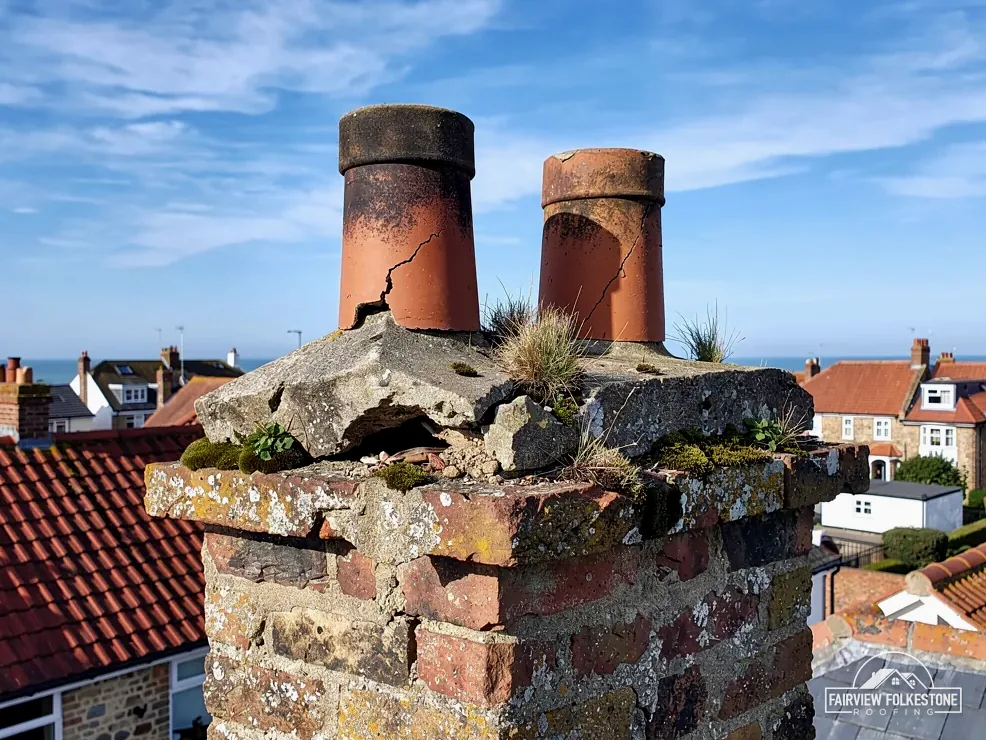
For the repairs themselves, see chimney flashing repair and chimney repointing, and for the whole range of stack work the chimney repairs page. Where the stack is leaning or has dropped bricks, tell your neighbour at once, as it affects both homes.
More questions
Can my neighbour refuse to let me repair my side?
A neighbour who has sent no consent within 14 days of a party structure notice is treated as dissenting, and a surveyor then settles the dispute, agreed or one for each side. Staying silent does not block the work for good. A neighbour may also consent in writing so that work starts sooner than the two months. A party wall surveyor can check the details.
Who serves the party wall notice for a shared stack?
The building owner, meaning the person who wants the work done. The notice goes at least two months before work on a party structure begins. The survey can show whether the work is likely to touch the party wall, but questions about the notice itself belong with a party wall surveyor.
More on chimney repairs
All guides and posts

Tell us what's wrong with the roof.
You'll get one written total price.