
Factory rooflights
How are fragile rooflights on industrial roofs replaced?
Rooflights in an industrial roof can fail without warning, so the method protects the crew first and the building second. Below: the safe approach, the steps and the rules.
The short answer
Rooflights are replaced from a safe platform, never by standing on the old unit. Every rooflight in a sheet roof is handled as fragile until checked, so boards, a mobile platform or edge protection go in before anyone works beside one. The old light comes out, the sheets and sealing round the opening are inspected, and a new unit goes in to a plan agreed in advance.
5 min read · Part of Commercial roofing
Why rooflights count as fragile
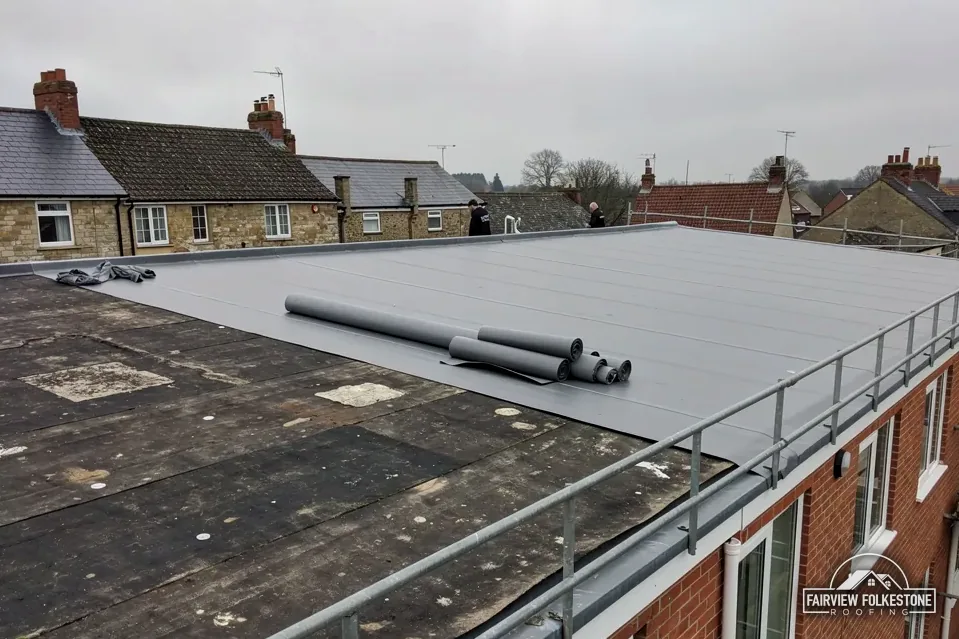
A rooflight can look as solid as the sheets around it and still give way under a person's weight. Age and weathering can make a rooflight brittle, and dirt or paint on its surface hides the difference between it and the sheet beside it. From the roof surface, the two can be hard to tell apart.
For that reason a rooflight in any sheet roof gets the fragile label until someone has checked it, and the crew works beside it from boards or a platform. HSE goes further for one kind of roof: asbestos cement roofs rate as fragile in every case, so where a cement sheet roof carries rooflights, the whole slope is treated that way.
Falls through roofs cause serious injuries, so access is planned before the quote is given and before the date is fixed. Our page on fragile roofs and CDM duties sets out who carries what for the people on and around the roof.
Where a rooflight is already cracked, broken or missing, the opening is covered and marked as a hazard until the replacement is done. A broken unit is never lifted out by hand from above without edge protection in place.
How the replacement is done
The sequence keeps the crew supported at every stage.
- Survey the roof: the sheets, the rooflights, the fixings and the access route.
- Check the sheets for asbestos before any are disturbed, and plan the work to suit the result.
- Set up edge protection, boards or a mobile platform, so that no one works from the unit itself.
- Release the fixings and lift the old rooflight out whole where it will come, without breaking the sheets around it.
- Check the sheet edges, laps and sealant strips at the opening, and renew whatever has perished.
- Fit the new rooflight with new washers, and seal the laps.
A new rooflight has to match the profile of the sheets around it, so the profile and the maker's details are written down at the survey, before anything is ordered.
Where the roof is cement sheet, the asbestos rules apply to the sheets as well as to the rooflight, as our answer on an asbestos cement roof explains. A new unit also has to be ordered to suit what the survey finds, so the lead time is agreed with you early.
What the new rooflight must meet
Replacing a rooflight is a change to the roof, so rules come into play even when the opening stays the same size.
- Building Regulations. AD L 2021 Table 4.2 sets a limiting U-value of 2.2 W/m²K for a new rooflight, but that table is written for dwellings. For a factory or unit, building control confirms the standard that applies.
- Fire. A new covering whose fire performance would be significantly different needs approval under the Planning Portal's guide, so the rooflight's fire rating is written into the specification before anything is ordered.
- A construction phase plan, drawn up for the project under CDM 2015, with the principal contractor responsible where several contractors share the site.
- Wildlife. Bats are protected, and GOV.UK's bat guidance lists roof repair and replacement among activities that can disturb them, so any roof void is checked before work begins.
Our answer on commercial roof building regulations explains how building control becomes involved, and how to find the right team for your address. If the building is let, tell the landlord or managing agent early, because their consent can take time.
Working in a factory that keeps running
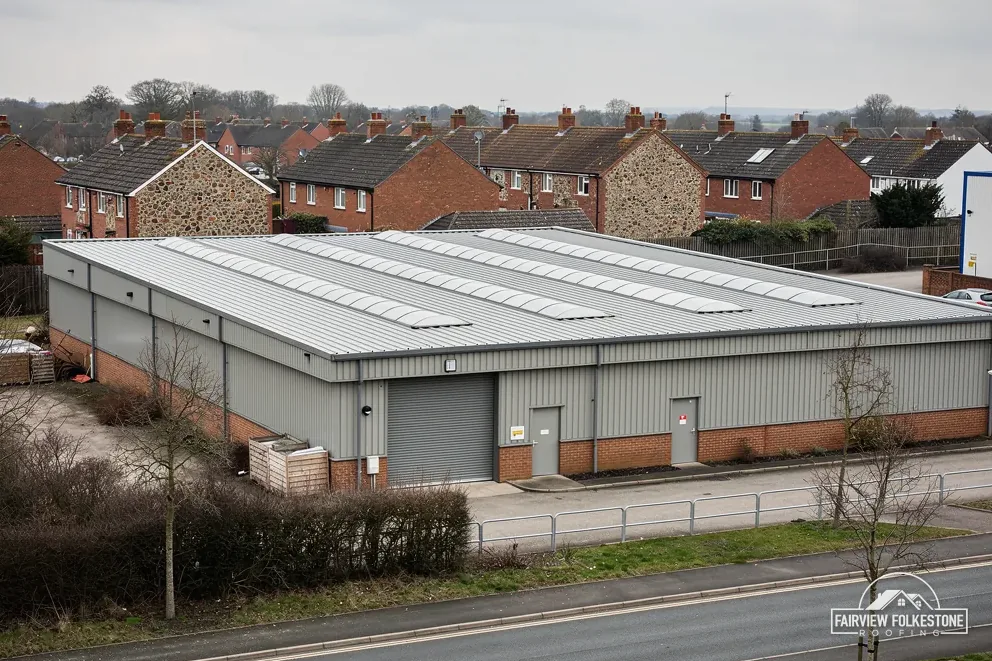
Rooflights sit over the working floor, and the work above them affects whoever is below. Three things are planned with whoever manages the site.
First, the floor under the opening. Debris, dust and a dropped tool are all risks to people and stock below, so the area is cleared or protected and a drop zone is marked out. Second, the opening itself. It is covered or closed at the end of each shift, so rain cannot reach the floor or the machinery. Third, the old unit and its waste. If it is asbestos cement, or sits among asbestos sheets, the waste goes into a lockable skip and travels under a consignment note.
On a roof with several rooflights, the work can be taken in stages, one bay at a time, so that the building keeps running. We agree the order with you at the survey, and the plan shows which machines or work areas sit under each opening, so nobody is surprised on the day. Where a line has to stop while a bay is open overhead, the stop time is agreed in advance and written into the plan.
You receive one written total price, and the survey comes first. Our commercial roofing page covers the roof types we survey.
More questions
Is every old rooflight in a sheet roof dangerous to walk on?
Treat every one as fragile until it has been cleared by an inspection. Weathering can make a rooflight brittle without changing how it looks, and a unit can fail under weight with no warning. We work from boards or a platform beside it, and never put weight on the unit itself.
Can new rooflights be fitted without replacing the sheets?
Sometimes, where the sheets around the opening are sound. The survey checks them, along with the laps and fixings. If the sheet edges are corroded or the sheets are cement, they may need replacing as well, so the plan is agreed with you before the price is given.
More on commercial roofing
All guides and posts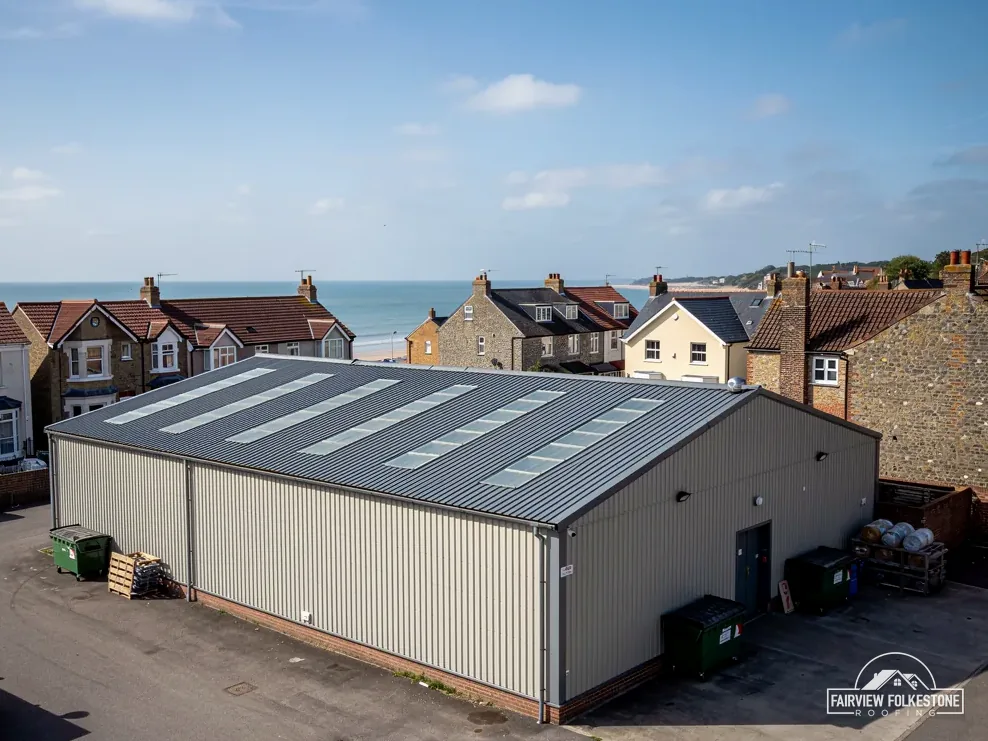
Tell us what's wrong with the roof.
You'll get one written total price.