
Ponding water
Is ponding water on a flat roof a problem?
A pond on a flat roof is a fall problem first and a leak risk second. Below: the standard, how to read the pond, and which fixes last.
The short answer
It depends on how long the water stays and what lies under it. A shallow pond that clears on a sound roof is something to watch, while water that never clears, or that sits over a soft deck or a stained ceiling, needs attention. Ponding means the fall is not carrying rain to the outlet, and BS 6229:2025 sets a minimum finished fall of 1:80 for that reason.
4 min read · Part of Flat roofing
What the standard expects
BS 6229:2025 is BSI's current standard for membrane flat roofs, and its 2018 edition is withdrawn. The NFRC, summarising the 2025 edition for members, says it asks for a minimum 1:80 finished fall over general roof areas and internal gutters. IKO, a membrane maker, gives its reading of the code: a roof drawn to 1:40 so as to deliver 1:80.
In plain terms, 1:80 is 12.5 mm over a metre, which is why a roof can feel flat underfoot and still sit within the standard. Because the standard speaks of the finished fall, it is the roof as built that counts, not the roof as drawn.
The gap between the two figures is deliberate. The finished roof is the one that has to reach the minimum, and a drawing figure that sits steeper gives the build some give.
IKO also describes a separate case: a certified system intended as a zero-falls roof. That is a particular product with its own paperwork, not an ordinary roof laid flat, so the first question on a survey is which kind of roof you have.
How we read a pond
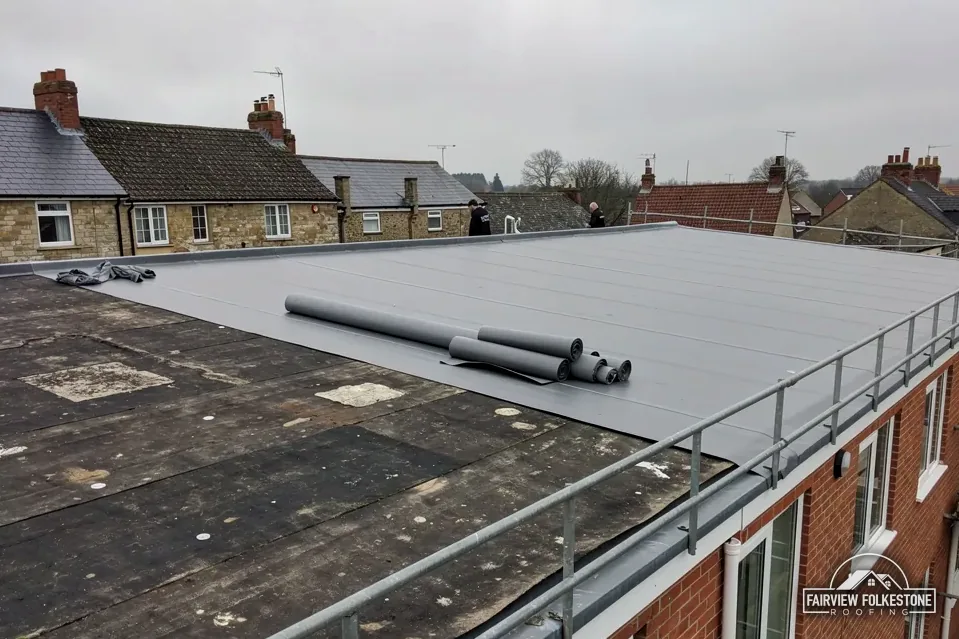
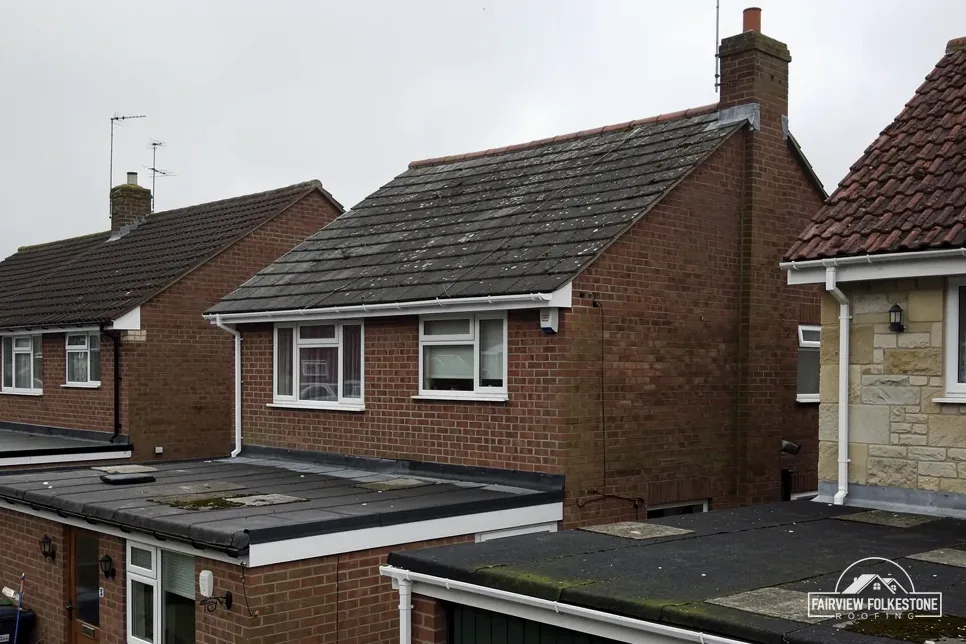
Standing water is easier to read after rain than in a dry spell. Where we cannot see it wet, the rings of dried dirt left behind on the membrane mark where water has lain. A pond is a clue, and the table sets out what it can point to.
| What we see | What it may mean | Next step |
|---|---|---|
| Water ringing a blocked outlet | Outlet needs clearing | Clear it |
| A pond far from the outlet | Fall too shallow | Check the fall |
| A dip along one joist line | Joist has sagged | Open up and look |
| Pond over a springy deck | Boards soaked | Renew the deck |
Take a photograph of the pond from the same spot after each rain, so any change in its size shows. We also note how far from the outlet the pond sits, how deep it looks at its centre, and whether the same spot holds water after each fall of rain. A pond that moves around the roof with the weather points somewhere different from one that sits fixed in a corner.
What lying water does to a roof
A membrane is made to keep water out, so a pond is not the same as a hole. What changes is how long every seam, lap and upstand under the pond sits wet. Water that stays puts a constant demand on the weakest joints, and anything that has started to open, such as a lap or a patched corner, is tested again with each rain. Dirt and leaves settle in the pond and block the outlet beside it, which makes the next pond bigger.
Beneath the membrane, the deck is what suffers if a joint gives way. Wet boards weaken, and a soft deck turns the verdict from a repair into a replacement. Over a bedroom or a kitchen, a ceiling stain that returns is the first sign.
This is why a pond is a reason to look, and why the look includes the deck. A roof that has ponded for years and shows no damp below differs from one with a fresh stain, and the survey tells them apart. A pond near the wall can also soak the upstand, so we look at the wall joint whenever water is standing close to it.
Fixes that last and fixes that only hide it
The fix depends on the cause. In order of effort:
- clear the outlet and the gutter below it, which costs little and is worth doing each autumn
- add a second outlet, or move one to the lowest point of the roof
- lay tapered firrings or sloping insulation boards beneath a fresh membrane, which changes the fall itself
- replace sagging joists or soft boards before any new covering goes on
A coat of paint or a layer of liquid coating over the pond only hides it. It does not change where the water goes. Brett Martin, a guttering maker, advises a fall of 1 mm for every 600 mm towards the outlet for guttering, a different job from the roof but the same principle.
Keep an eye on the outlet after any fix, because a blocked outlet will undo even a good fall. A look from the ground or a window is enough to spot a build-up of leaves; going onto the roof is a job for someone equipped for it.
Our flat-roof fall answer has the figures in millimetres, and the flat roofing page explains how the verdict is reached.
More questions
How deep does a pond have to be before it matters?
There is no single depth that separates harmless from harmful. What counts is whether the water clears, how long it stays, what lies under it and what the fall measures. A shallow pond that dries up on a sound roof is a watch item, while one that never clears, whatever its depth, calls for a closer look.
Can ponding be cured without a new roof?
Sometimes. Where the covering is sound and the boards are dry, clearing a blocked outlet or adding a second one can be enough. Changing the fall itself takes new firrings or tapered boards, and these go under a new membrane, so a roof with a poor fall needs more than a patch.
Tell us what's wrong with the roof.
You'll get one written total price.