
Lead valley repair
Can a leaking lead valley be repaired?
A leaking lead valley can be repaired when the lining is whole and the leak comes from what sits around it. Below: the checks, the fixes and when to renew.
The short answer
Yes, where the lead lining is still whole and the leak comes from what sits on or beside it. A valley blocked with moss and debris, or a cut slate that has slipped, lets water over the edge of a perfectly good lining. Clearing and refixing cures both. Where the lead itself has split, creased or worn through, a repair will not hold, and the lining needs renewing along that stretch.
4 min read · Part of Lead work
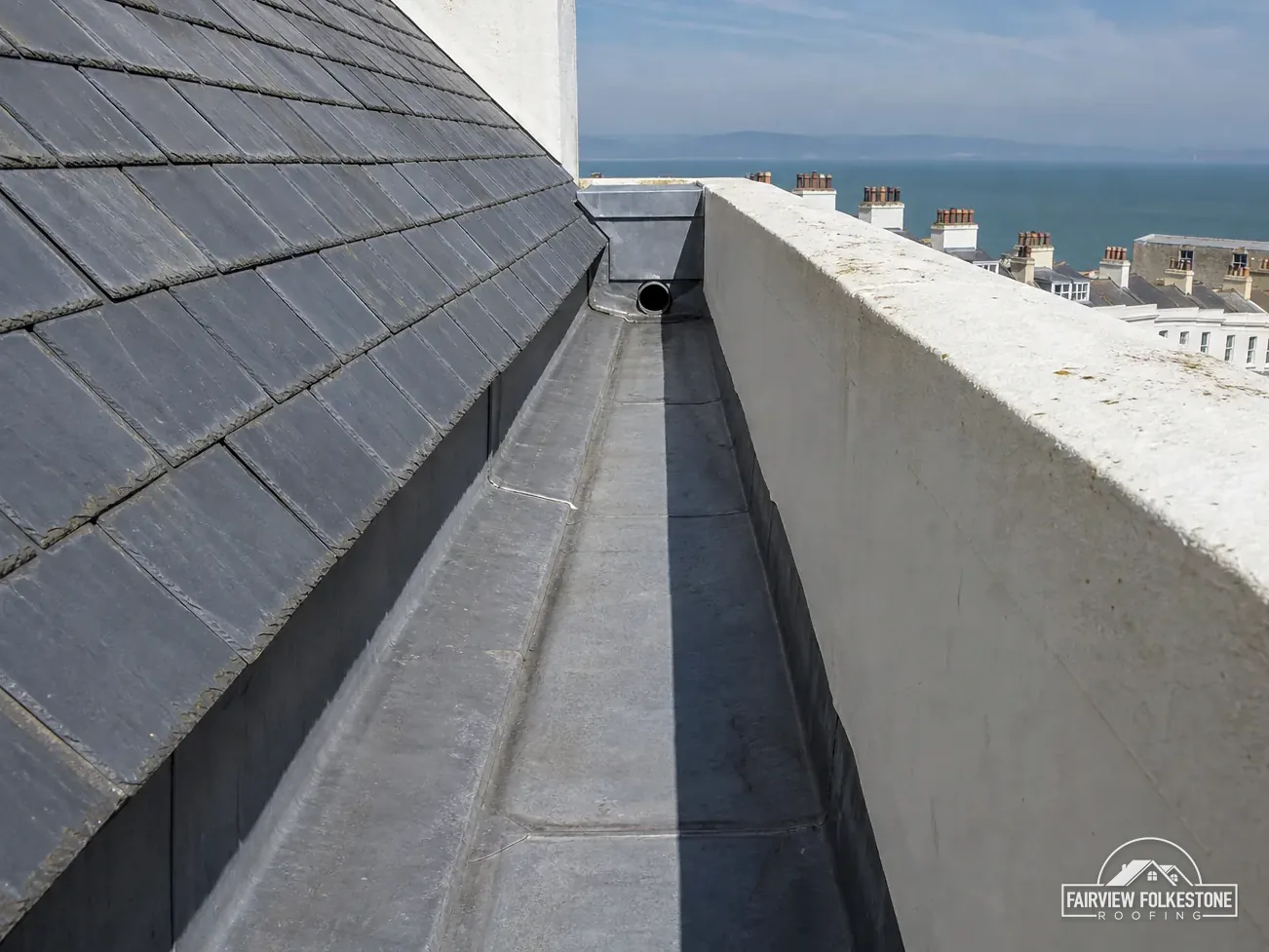
What a valley does, and how it leaks
A valley is the channel where two roof slopes meet at an angle and run down to a gutter. In a lead valley, a lining of lead sheet sits on a timber valley board, and the slates or tiles on each side are cut to run along it, leaving a strip of lead showing. Everything on both slopes drains into that channel, so it handles the heaviest flow on the whole roof. Debris from both slopes ends up there too.
When a valley leaks, the cause is one of four things:
- The channel is blocked, so water backs up and spills over the edge of the lead
- A cut slate or tile beside the lead has slipped or cracked
- The lead itself has split, usually along a fold or a crease
- The valley board or the timber beneath has rotted and let the lead sag
Only the third and fourth call for new lead. The first two are put right without touching the lining, which is why we check them before anything else and before talking about cost.
Repairs that work on a valley
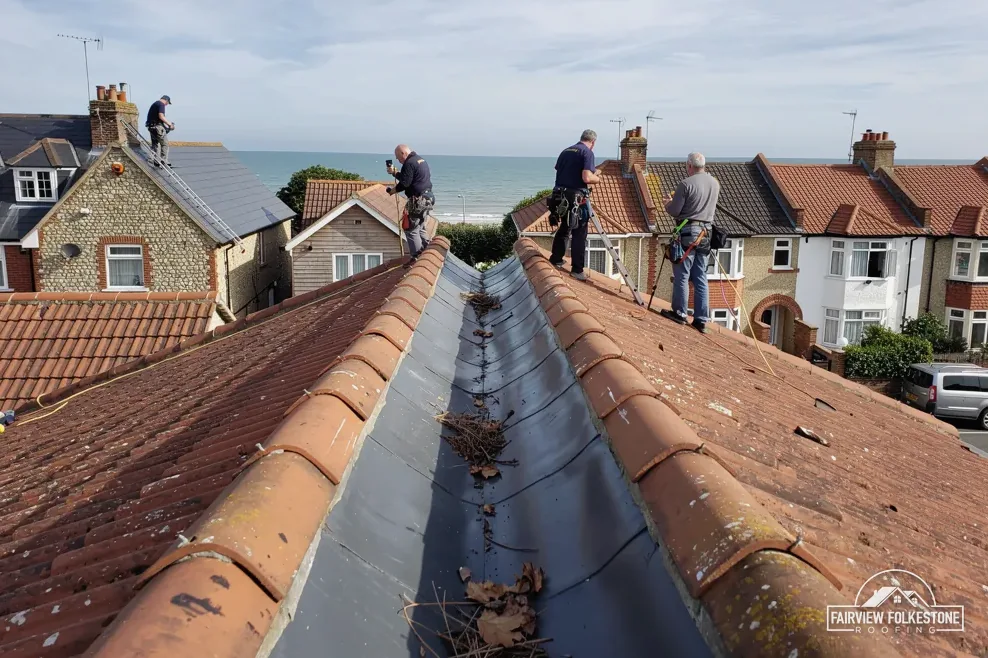
Start with the simplest cause, which is what is sitting in the channel. Moss, leaves and silt can dam a valley and make water ride up and under the slates. Clearing it, and checking that the lead runs clean from top to bottom, is a repair in itself, and sometimes it is all that is needed.
After that, the work depends on what we find:
| What we find | What it needs |
|---|---|
| Channel blocked with debris | Clear and flush it |
| Cut slates slipped or cracked | Refix or replace them |
| Small tear in sound lead | Local lead repair |
| Splits along the length | New lead lining |
| Soft or rotten valley board | New board, new lead |
A small tear can be mended with new lead let in over it, but only where the lead around it is sound enough to take it. If the metal beside the tear is thin or creased, the patch has nothing good to bond to, so the honest call is to price a new lining instead.
When the lining needs to be renewed
A valley lining that has split along its length cannot be patched for long, because the channel is never still. It warms in the sun, cools at night and takes the weight of a whole roof slope's rain, so a weak point opens again. Splits in several places, lead worn thin at the lowest point, or a lining creased and flattened by foot traffic are the signs we look for before suggesting new lead.
Renewal means lifting the slates or tiles along both sides, taking out the old lead, checking the valley board and rebattening where the timber is soft. The new lead goes in as one length where the run allows, with the covering relaid either side. Royston Lead lists Code 4 as its lightest code for a pitched valley gutter, and Code 5 is the lightest it lists for the flat-bottomed box and parapet types, so the code follows the kind of valley on your roof.
Our answer on why lead flashing cracks explains the movement that splits lead in the first place, and it applies to a valley too.
How we survey and price a valley
We look at the valley from outside first, then from the loft, where a leak shows as stained rafters, a wet valley board or daylight along the line of the lining. We photograph both sides and send you the pictures, so you can see the fault for yourself. The survey tells us whether this is a clear-out, a slate refix, a local repair or a new lining, and we say which before any price is given.
What sets the price is the length of the valley, the code of sheet, how much of the covering has to come off either side, and how the roof is reached. Your quote arrives after the survey as one total in writing, and it says whether scaffold is included. A long valley over a stairwell or a rear extension is harder to reach than a short one over a porch, and that difference shows in the total. For the figures published by cost guides on lead work, see our lead flashing repair cost answer, and for the bigger picture, the lead work page. Where the lead is sound we repair, as in our answer on whether lead flashing can be repaired.
More questions
Can I clear a blocked lead valley myself?
Clearing from the ground with a long pole is possible, but a valley sits at the lowest point between two slopes, where a slip is most dangerous. Never walk in the channel, because lead creases and splits under foot. If you cannot clear it from a safe position, have a roofer do it and check the lining as well.
Is a leak under a valley always the lead?
No. A blocked channel, a slipped slate or a failing valley board leaves the same stain on the ceiling as split lead. The survey therefore checks each cause in turn, starting in the loft and then moving outside, before deciding. Renewing sound lead because of a leak that came from a blockage would be money spent without fixing anything.

Tell us what's wrong with the roof.
You'll get one written total price.