
Camber · 29.5 road miles south-west
Roofers in Camber
A village of 1,132 residents in its parish, about 41 minutes from Folkestone by road. Photographs of the roof come to us first, and a written verdict on each fault goes back to you before any figure is mentioned.
- Sign-off for a re-roof
- East Sussex Building Control Partnership, 01892 602005
- Conservation areas
- Rother District Council keeps the list to check
- Flood Zone 3, Environment Agency
- The centre of Camber falls in this zone
- Scaffold on the road
- East Sussex Highways licence, £127 for 28 days
Three faults a Camber survey puts a verdict on
What we found
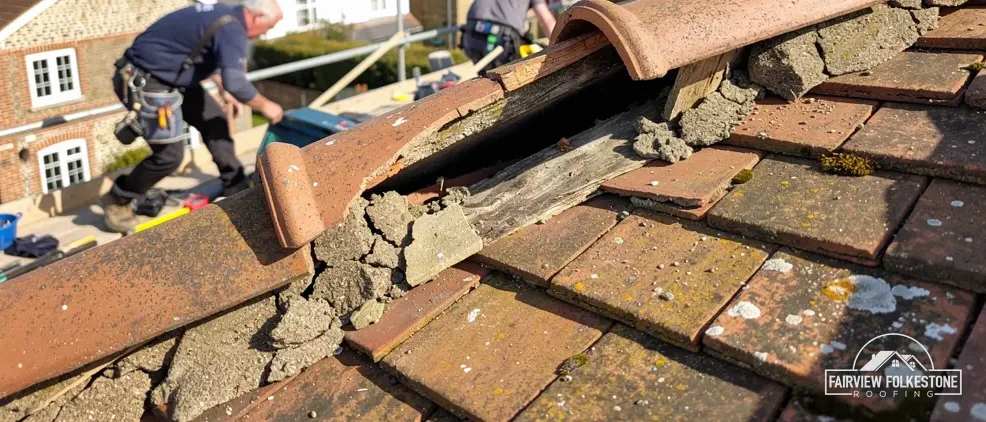
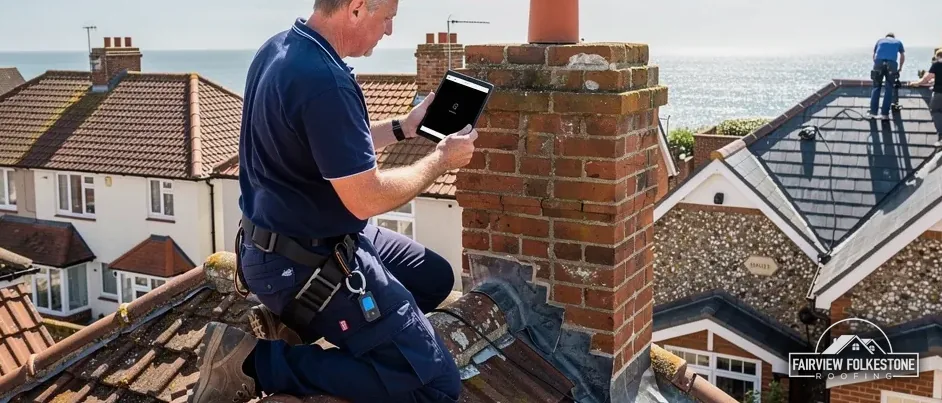
Ridge bedding cracked, tiles still sound
What it fairly needs
Bed it again with fixings.
What we found
Address near an Article 4 direction
What it fairly needs
Ask Rother before any price.
What we found
Tiles lifting right across a slope
What it fairly needs
Re-cover it to a new fixing schedule.
The fair ledger
Fixings near the coast, council checks and eaves reached from the road
Camber's centre lies 0.17 miles from the coastline, sits in Flood Zone 3 on the Environment Agency's map and falls under Rother District Council. Three entries follow, each closing on a verdict for the roof.
Entry 01Fixing schedule
Close to the coastline: how a Camber roof's fixings are worked out
Cupa, a slate maker, writes that a building in a coastal area will be graded with higher exposure. For a roof 0.17 miles from the coastline, the survey starts with how the covering is held down.
Exposure first, fixings second
Cupa names exposure to wind and rain as the two main factors in a roof's surroundings, and a coastal setting raises the grade. We take that to mean the fixing schedule is a calculation for the address, made under BS 5534, and never a copy of the last job. Marley describes the code as covering batten selection, methods of fixing, wind uplift formulas and a way of calculating the fixing specification.
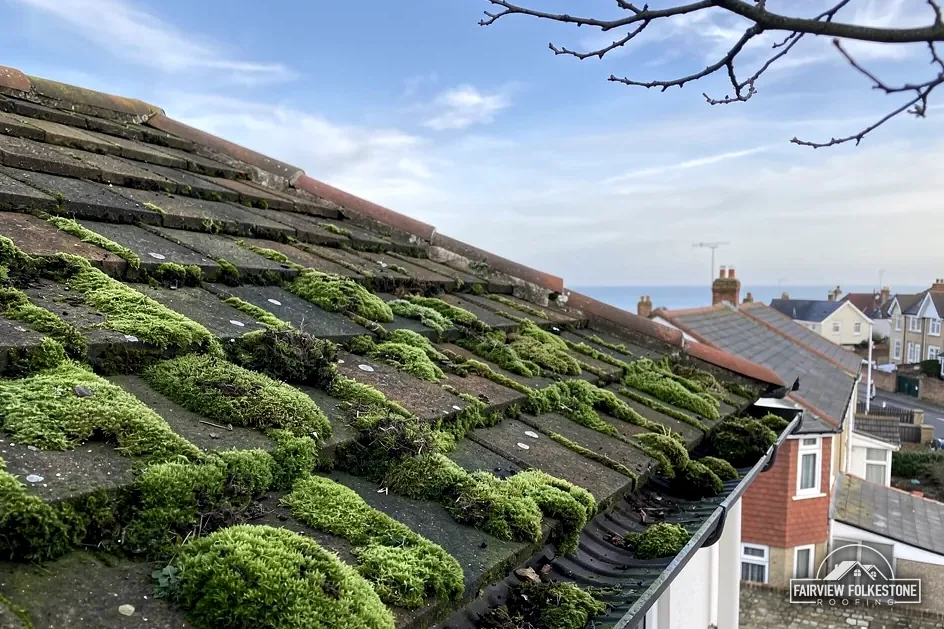
What the survey can do is record what holds the covering today, so that any new schedule answers a real roof rather than a typical one. The reasoning goes into the write-up, with the photographs beside it, so you can follow why each fixing is where it is and ask about any of it.
- Tile or slate on top
- Batten that carries it
- Underlay beneath the battens
- Rafter below it all
What we record in the loft and on the slope
- Which battens are sound, and where one has split or softened.
- The underlay at the eaves and at the ridge, seen from the loft side.
- Tiles or slates that have shifted, and the clips or nails that remain.
- Any mortar still carrying a load that a mechanical fixing should carry.
Marley says BS 5534 is not required by law, but its 2015 amendments made clear that mortar by itself cannot be trusted to keep a covering on the roof. Where only a few fixings have failed and the battens are sound, the verdict is a repair, and the roof stays as it is. Where the schedule has failed along a whole slope, the verdict is a re-cover, and the survey shows why. Our pitched roofing page sets out how a re-cover is built up, layer by layer.
BS 5534
the code of practice for fixing slates and tiles
Marley: not required by law
Entry 02Rother checks
Four questions for Rother District Council before a Camber price
Camber sits in Rother District Council's area, and that council is the place to confirm any conservation area, Article 4 direction or listing that touches your house.
Conservation, Article 4 and listing
Whether your address lies in a conservation area is for Rother District Council's own list to answer, so we ask Rother and never guess. An Article 4 direction can remove further rights, and one is recorded in the area around Camber, so check with Rother District Council before work is priced. A direction that sits near a village need not touch your road, which is why the question goes to the council with your address attached.
A listed house is a different question. The Historic England list shows which buildings are listed, and a listed home keeps its permitted development rights for roof work, though consent under section 7 of the Planning (Listed Buildings and Conservation Areas) Act 1990 is needed for work that affects its character. Our planning guide for roof work covers what changes for a dormer or an extension.
Myth: Rother's own team handles building control for a Camber roof.
Fact: Building control for Rother addresses sits with the East Sussex Building Control Partnership, which serves four councils together.
Hip tiles loose, battens sound
Refix them
Listing or direction not yet known
Council first, then price
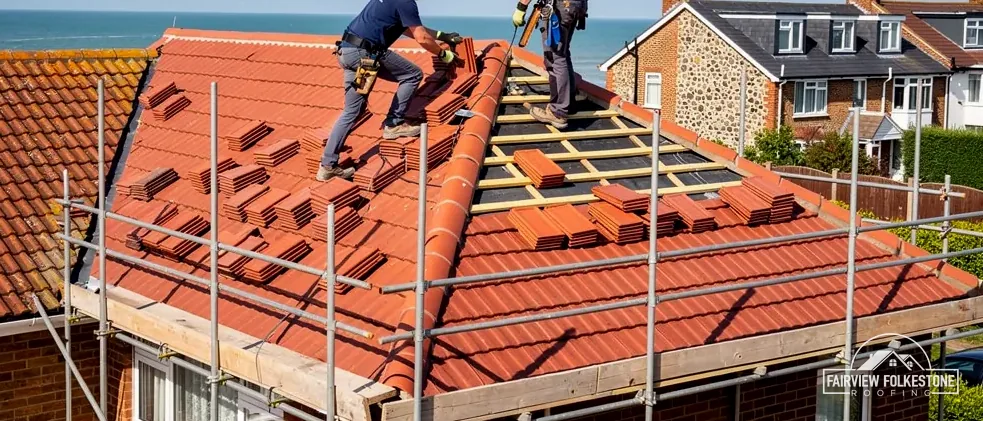
Underlay perished across the slope
Strip and re-cover
Building control for a re-roof
The Planning Portal's test is that re-roofing does not normally need a building regulations application when it affects less than 25 per cent of the building envelope and less than 50 per cent of the roof. A covering weighing 15 per cent or more beyond the old one needs approval as well, so the survey notes the old and the new coverings side by side, and any change of material is raised with building control before a price exists.
For building control, Camber is covered by the East Sussex Building Control Partnership, which carries out building control for Eastbourne and Hastings Boroughs and Rother and Wealden Districts. Phone the building control partnership on 01892 602005 if you want its view before we start. We keep any written answer with the survey, and it travels with the photographs if the roof is ever looked at again. The survey photographs are kept to hand for that call, so the question can be put with the roof in front of both of you.
Who arranges the licence
East Sussex County Council is the highway authority for Camber, and East Sussex Highways runs the licensing for scaffolding on a road. We arrange the licence with our scaffolder, so no form lands on you. Its terms set a walking passage of at least 1.5 m for pedestrians and keep the scaffold no closer than 450 mm to the edge of the carriageway. An extension must be requested at least five working days before the licence runs out, so a job that overruns is planned for, never improvised.
Scaffold is part of the written price, so it never turns up later as an extra. A scaffold that stands for the whole job also lets the ridge, the verge and the gutter line be checked in one visit instead of three. The roof inspection page shows what we photograph before any scaffold is ordered.
Entry 03Eaves access
Reaching Camber eaves: the highway licence and a gutter that drains
Reaching eaves can mean scaffold, and scaffold on a road needs a licence. With that settled, the fascia, the gutter and the soffit each get a proper look.
What sets the price
- Height of the eaves
- Length of the run
- Whether scaffold stands on the road
One written total price
- Fascia board
- Gutter on its brackets
- Underlay lapping into the gutter
- Soffit and its vent
Fascia, gutter and soffit from the platform
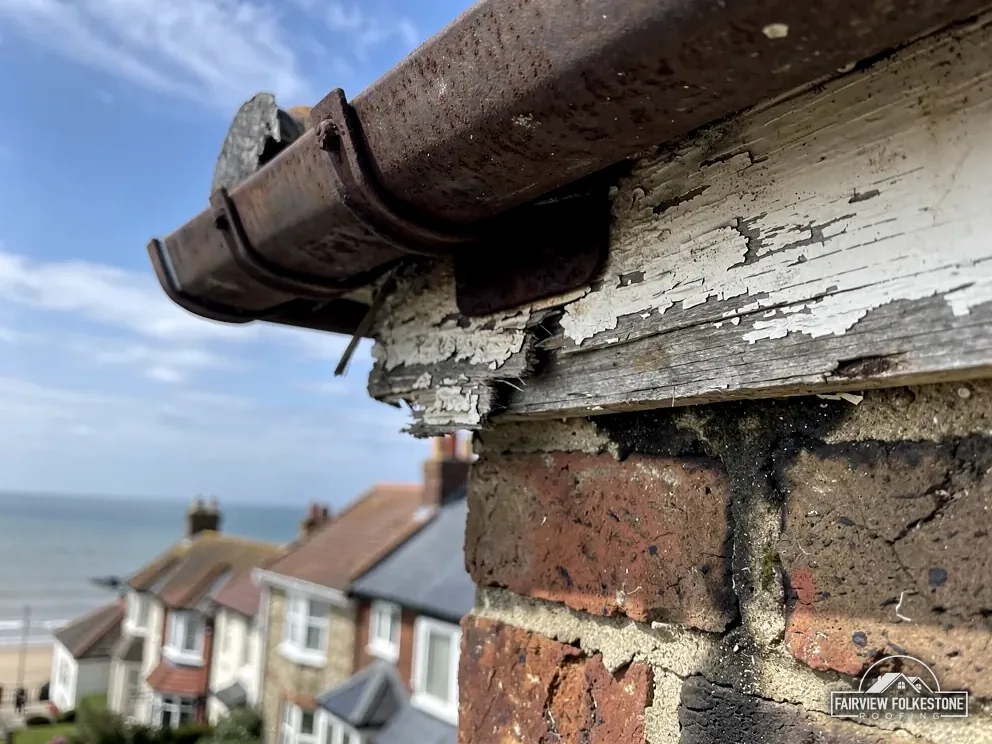
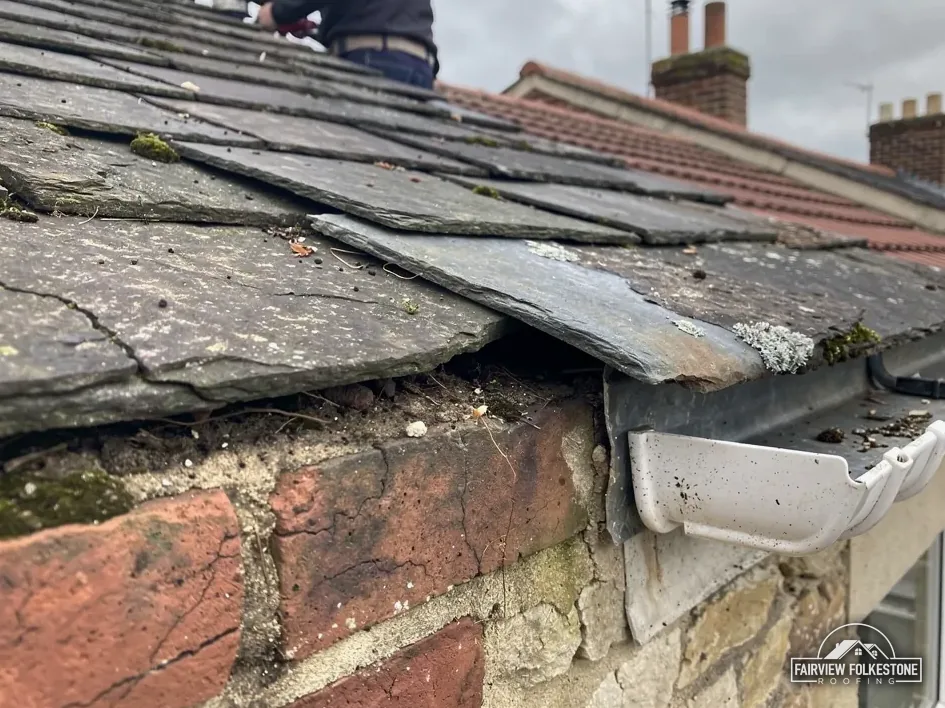
Once the platform is up, the eaves can be read at arm's length. We check that the fascia is firm enough to hold the gutter brackets, that the gutter falls towards its outlet, and that the underlay laps into the gutter instead of stopping short. Brett Martin advises a fall of 1 mm for every 600 mm towards the outlet.
A sagging run on sound brackets is a refit, and a split run is a replacement. A fascia board that has gone soft along its lower edge is noted at the same visit, since the brackets are only as good as the board that carries them. The soffit vent is checked too, because a blocked vent leaves the loft without its air. Downpipes and outlets are looked at while we are there, since a gutter that drains well on paper can still be held up by a blocked outlet. Our gutters, soffits and fascias page shows the work in more detail.
Forty-one minutes down to Camber
Camber is 29.5 road miles south-west of Folkestone, about 41 minutes by car, and the 2021 Census counted 1,132 usual residents in the parish. The Environment Agency flood map places the centre of the village in Flood Zone 3. A few photographs help before anyone sets out: the whole roof first, then a close view of the fault, taken from wherever you can stand safely. Our reply asks about the loft, the gutters, any stains on the ceilings and when the roof last leaked, and the survey is booked after that. The survey is done house by house, so a general picture of the village never stands in for a look at your own roof.
Roof questions from Camber
Does a Camber roof need different fixings because it stands near the coast?
Because Cupa reports that coastal buildings are graded as more exposed, BS 5534 is the code used to calculate how that particular roof is fixed. Marley says that code is not required by law, though after the 2015 changes to that code, mortar alone is not treated as enough to secure tiles or slates. The survey records the battens, underlay and fixings you have today, and the written verdict then says whether a repair or a re-cover fits the roof in front of us.
Who do I ask about listing or conservation status for a Camber house?
Rother District Council is the council to ask about conservation areas and Article 4 directions, since a direction can remove further rights. The Historic England list shows whether a building is listed, and a listed building needs consent before work that would change its character. We put your address to Rother District Council before any price is given, and you see its answer in writing.
When does swapping a Camber roof covering need Building Regulations sign-off?
The Planning Portal gives two limits: less than 25 per cent of the building envelope and less than 50 per cent of the roof. A covering weighing 15 per cent or more beyond the old one also needs approval. For building control, the East Sussex Building Control Partnership answers on 01892 602005, and the survey shows where your job sits against both limits before a price is written.
What does a scaffold licence cost on a Camber road, and who arranges it?
East Sussex Highways' fee table shows a scaffolding licence at £127 for 28 days; confirm the current fee with East Sussex Highways before relying on that figure. We arrange the licence with our scaffolder. Any extension must be requested at least five working days before the licence expires, which is why a long job is planned around the 28 days from the start. Scaffold sits inside the one written price, so nothing is added to it afterwards.
Does Flood Zone 3 change how a Camber roof is repaired?
The Environment Agency flood map places the centre of Camber in Flood Zone 3. That describes the ground, and it is not a rule about roof coverings. A Camber roof is judged on its own condition: the battens, the fixings, the flashings and the gutters, which are exactly what the survey photographs and reports on, one fault at a time.
What does the survey of a Camber roof put in writing?
You receive photographs of each fault, a verdict on each one, repair or replacement, with the reason, and, where a council's view matters, what Rother District Council tells us. The one written total price follows last, never first. Nothing is lifted or taken apart during the survey itself, so the visit leaves the roof exactly as it was found. If a loft corner could not be reached on the day, the write-up says so plainly.
Send over the Camber roof for a verdict
You'll get one written total price.