
Littlebourne · 17.2 road miles north
Roofers in Littlebourne
Littlebourne has a Grade I church, a Grade I court barn and a listed restaurant on the national list, plus conservation areas that run on towards Ickham and Wickhambreaux. Your address gets looked up before the roof gets priced, then the roof is read slope by slope.
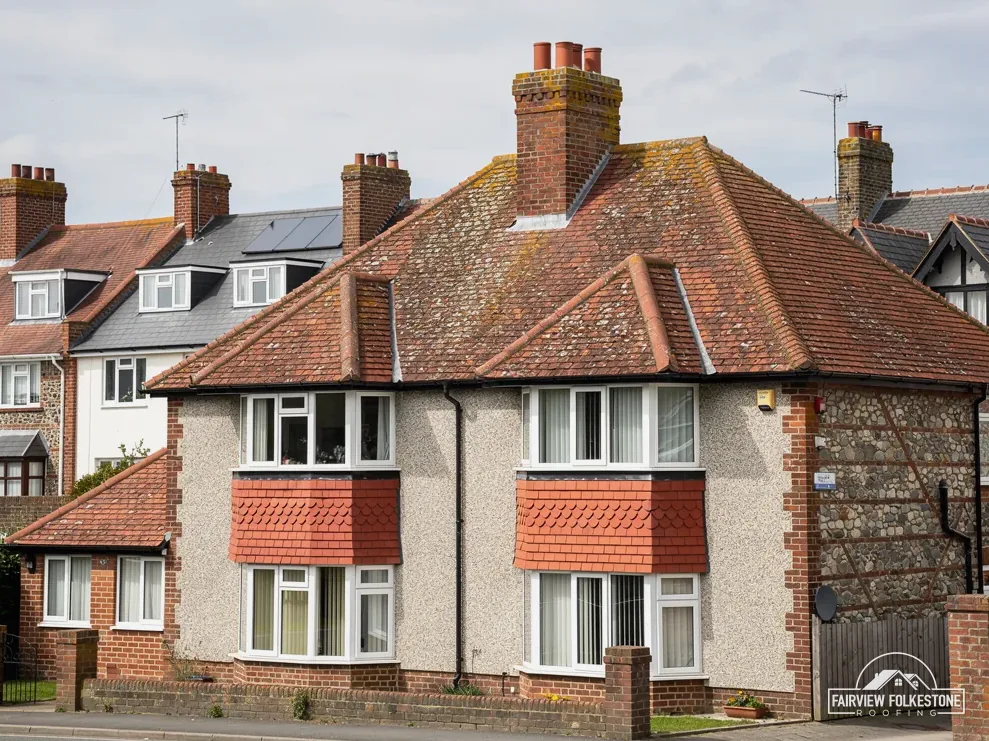
- Church of St Vincent
- Grade I; a Church of England church in use, so the Church of England's faculty system covers its works, and not the council
- Court barn
- The barn at Littlebourne Court is Grade I, so a roof job beside it starts with a consent question
- Scaffolding permit
- Kent County Council, £52 per week for 2026 to 2027; we arrange it with our scaffolder
- Drive from Folkestone
- 17.2 road miles, about 25 minutes by road
Beside the court barn and the church: three faults, three verdicts
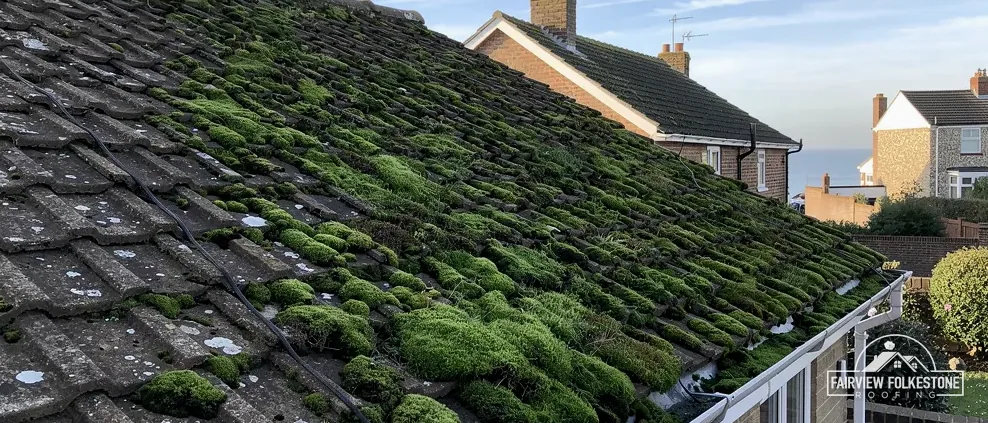
What we found
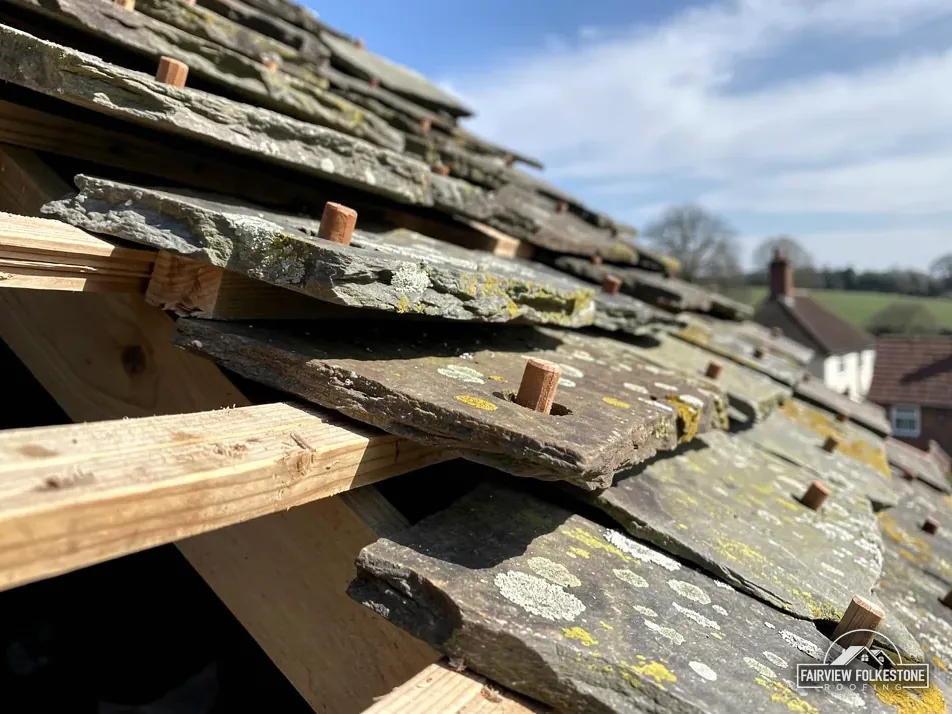
Green streaking and wet patches over a porch roof
What it fairly needs
Find where the water gets in before cleaning or replacing anything.
What we found
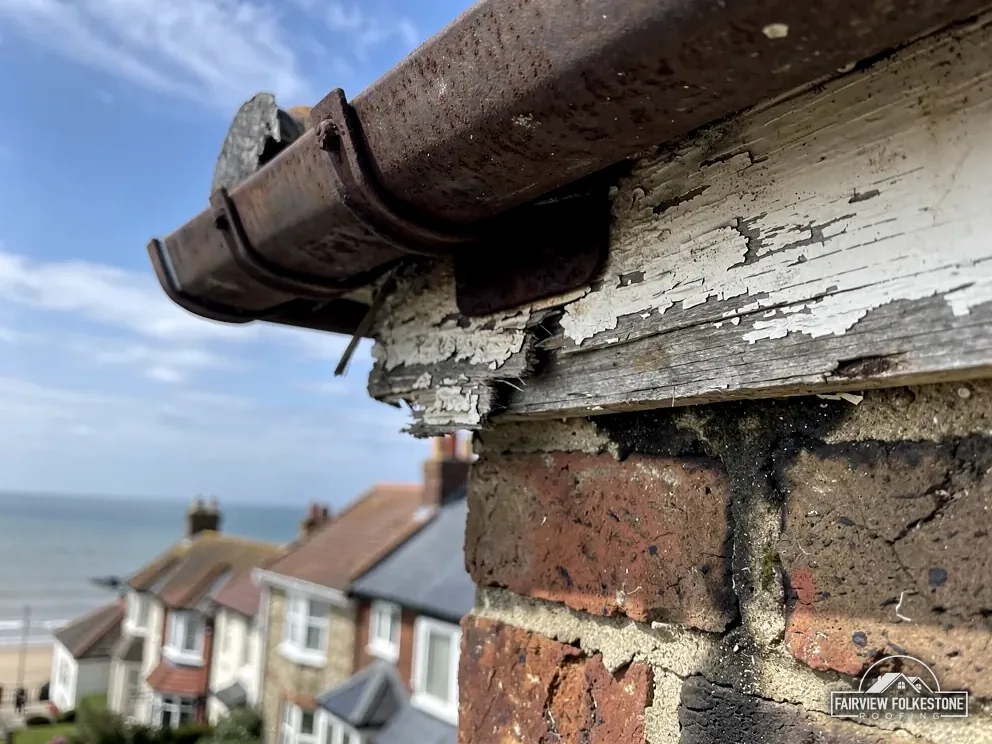
A gutter joint dripping onto the wall below
What it fairly needs
Reseal or replace the joint and rehang the length.
What we found
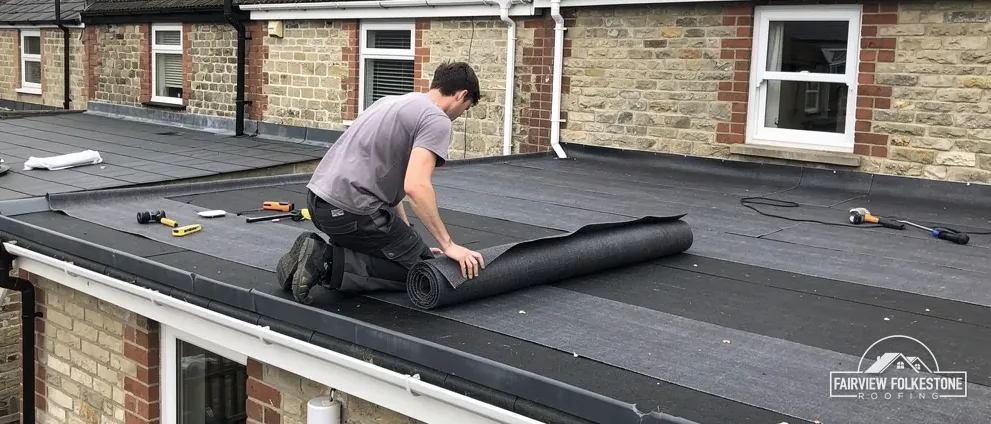
Flat roof on a lean-to, split at every seam
What it fairly needs
Strip it and lay a new membrane to a fall.
The fair ledger
Court barn, church and listed restaurant: your Littlebourne roof
Three listed buildings stand in Littlebourne, and Canterbury City Council lists conservation areas beside the village, so a house near any of them has a question to settle before the roof does. Each entry ends in a stamp.
Entry 01Listed neighbours
Court barn, St Vincent's and the Bow Window: who must be asked
Historic England lists two Grade I buildings and a Grade II restaurant in Littlebourne, and each carries a consent question that a nearby roof does not share.
Listed roofs follow the Listed Buildings Act
The Church of St Vincent (list entry 1051071) and the Barn at Littlebourne Court (1085595) are Grade I, and the Bow Window Restaurant (1085604) is Grade II. A barn or a restaurant is treated just as a house is: the Listed Buildings Act covers the building itself, whatever its present use, so its roof gets no exemption from consent. A farm building put to new use falls under the same Act, so the address comes first and the roof second.
Where work would touch a listed building's character, listed building consent is required alongside the permitted development that roof work normally enjoys. The church has a separate route. St Vincent's is a Church of England church in use, so the faculty system of the Church of England covers works to it, and nobody should price or start anything there without that permission in hand.
Neighbouring houses are judged on their own entries, one by one. A listing does not pass from the court barn to the cottage beside it, and the National Heritage List will tell you in a minute whether yours has one. That search comes before pricing and its result goes in the file. For a restaurant or any other business roof, our commercial roofing page explains how those jobs are approached.
Myth: A barn roof is an outbuilding, so listing rules pass it by.
Fact: Listed building consent applies to the listed building, and a listed barn is as covered as a listed house; the question is whether the work affects its character.
Who decides if my Littlebourne house is listed?
Historic England keeps the National Heritage List, and a house counts as listed only if it has an entry there, which anyone can look up by address. Living beside St Vincent's or the court barn does not list your house. The address is searched before any pricing; a listed house means the quote is held for Canterbury City Council's reply on consent.
Entry 02Boundary lines
Ickham, Wickhambreaux and Littlebourne: conservation areas that meet
Canterbury City Council lists Littlebourne's conservation area beside a joint Ickham, Wickhambreaux and Seaton area and the Lee Priory and Garrington area, so lines run close to the village.
Names on Canterbury's list
Near the centre of Littlebourne the council lists Ickham-Wickhambreaux-Seaton, Littlebourne itself, and Lee Priory and Garrington, whose entry also names Ickham and Well. Canterbury has 97 conservation areas across its district, and a village that sits among several of them deserves a proper address check, made from the council's own information and not from a guess about the street.
Repairs go ahead inside a conservation area as anywhere, and re-covering the roof of a house is normally permitted development. Larger changes are where the care goes, and our planning permission guide covers them, from a new roof window to a change in the roof's shape. Canterbury City Council says properties in Article 4 direction areas lose some permitted development rights, so ask the council whether a direction applies to your house before booking anything that alters its outside appearance.
Our survey then does its own job. It separates the loose from the worn and the worn from the failed, slope by slope, so the council is asked about the roof you actually need and not about every small repair that might one day be wanted. Where nothing needs the council, the job simply carries on, with the stamps and the written price following in the usual way and no waiting for a reply that is not needed.
In a boundary or outside it
Plan to alter the roof's shape
Ask the council
Nail-sick tiles near the eaves
Refix with new fixings
Gutter run cracked end to end
Fit a new run
What moves a Littlebourne quote
- How much of the roof is involved
- Whether a consent question is open
- What lies under the old covering
- Reach for ladders and scaffold
One written total price
STG, the Portal test and a map label
Canterbury City Council uses the STG Building Control Partnership, which also serves Gravesham, Medway and Swale, and its number is 01634 331133 when a Littlebourne re-roof needs checking. Building control can also come from a registered approver, but in this district the partnership is where we begin, and we do not send a Canterbury question to any other office. Any reply from STG is kept with the survey notes, so the question and its answer stay together.
The Planning Portal's test is the national guide. Below 25 per cent of the building envelope and below 50 per cent of the roof, a Littlebourne re-roof normally needs no application, though approval comes into play for a covering 15 per cent or more heavier. Patching or refixing beneath an existing covering never reaches that question, and the survey tells you which kind of job you have before any price is set down. A heavier covering is also a structural question, and we raise it early, because a roof that cannot carry the new load needs a different answer from one that can.
The Environment Agency's flood map places land close to the centre of Littlebourne in Flood Zone 3. That describes the land and adds no step to a repair. See roof replacement for how a full re-roof is run.
Entry 03Checks and low ground
Building control for a Littlebourne re-roof, and what Flood Zone 3 means
Canterbury addresses go to STG for building control, the national Portal test marks where an application begins, and the flood map labels land without ruling on roofs.
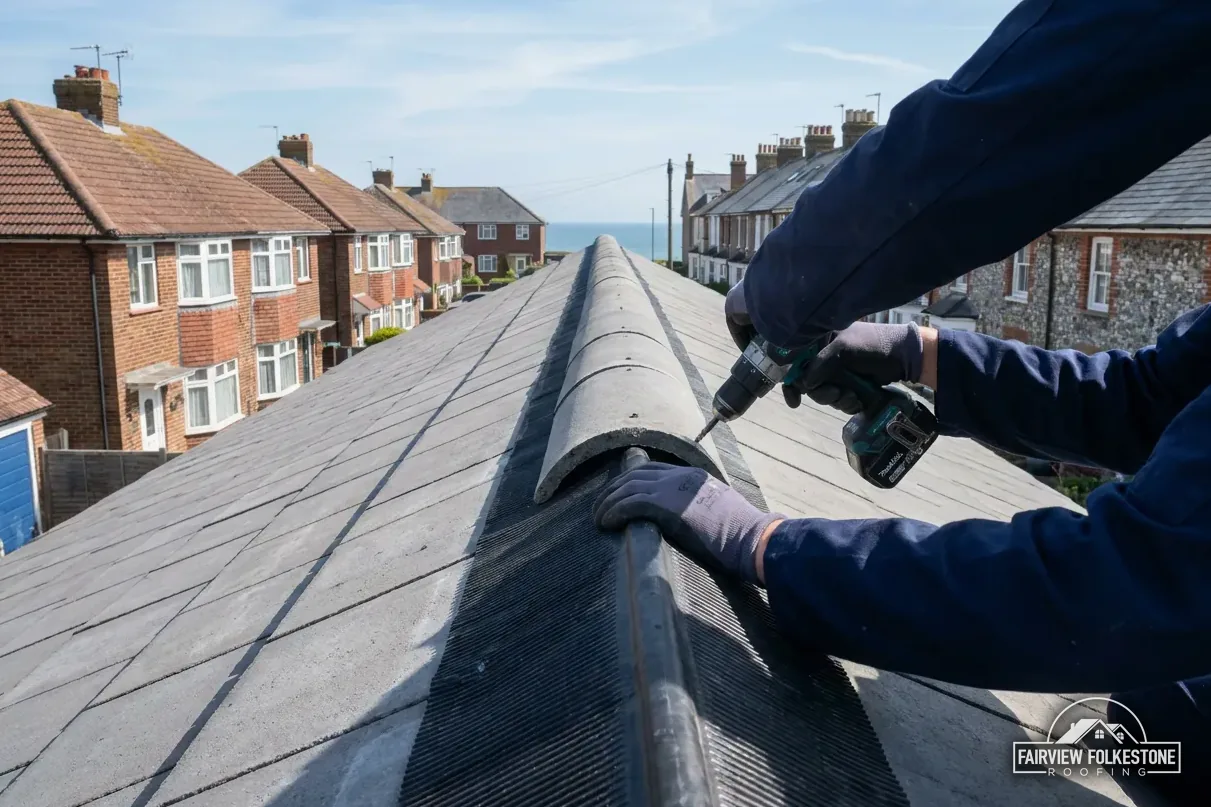
A boundary tells us whom to ask; the roof tells us what to say.
The ridge, from the top down
- Ridge tile on the apex
- Mortar bed beneath it
- Dry-fix clip holding it down
A ridge can be re-bedded or dry-fixed; the survey shows which fits the slope.
Does your Littlebourne roof need a council answer, or only a closer look?
Send your address and a picture of what is going wrong. We check where the house stands on listings and boundaries, mark what we find, and return one written price for the job.
Out to Littlebourne
Littlebourne is 17.2 road miles north of Folkestone, about 25 minutes in the van. At the 2021 Census the parish had 1,597 usual residents. With conservation areas close by, a trip does not stop at the roof itself: the address check, the survey of slopes, gutters and loft, and any question for the council all fit together, so one visit moves the job a long way along, and a second is needed only when the council or STG comes back with a question of its own, which we will explain as soon as it arrives.
Questions about Littlebourne roofs, barns and boundaries
Short answers for a village with a Grade I church and a Grade I court barn, and a boundary or two besides.
Can nail-sick tiles on a Littlebourne roof be refixed rather than replaced?
Yes, where the tiles themselves are sound and the battens under them still hold a fixing. Nails can rust through while the tile is perfectly good, so the survey lifts a few to look and checks the neighbouring courses along the same line. Refixing those tiles on new fixings is a repair, and it leaves the sound covering where it is. When the battens crumble along a stretch, or the tiles themselves are cracking, the answer changes, and you are shown the evidence first.
Does a Littlebourne house near the barn need listed building consent?
Only if the house is itself listed, and standing near the Grade I court barn does not make it so. The National Heritage List holds the answer for your address, and we search it before pricing, whichever lane or close the house is on. If the house is listed, consent is needed for any roof work touching its character, and the quote then waits for Canterbury City Council's reply on that point.
Do you need building control for a Littlebourne re-roof?
Canterbury uses the STG Building Control Partnership, on 01634 331133. Whether the job reaches it turns on the Planning Portal's test: a re-roof affecting under 25 per cent of the building envelope and under 50 per cent of the roof can normally go ahead without one, and a covering 15 per cent or more heavier needs approval. Work beneath an unchanged covering is a separate and simpler matter, and you hear which one applies before any figure is given, together with the reason.
How does the scaffolding permit work on a Littlebourne street?
Wherever scaffold blocks the pavement or carriageway of a Littlebourne street, a licence is needed from Kent County Council, which charges £52 per week for 2026 to 2027, each permit lasting 7 calendar days. Under Kent County Council's guidance the skip or scaffolding firm should lodge the application for you, and wants every application, renewals too, 5 working days ahead of the start. We arrange it with our scaffolder.
What will the surveyor look at in a Littlebourne loft and on the roof?
With a torch in the loft we hunt for pinholes of daylight, water stains on timber and battens that give underfoot. Outside we follow the ridge and hips, then valleys, gutters and any stack. Every finding gets a stamp, and one written price comes after the visit, with any council reply attached. Parts that cannot be reached safely are named in the write-up and not guessed at, and a photograph goes with each finding.
Is the flashing round a Littlebourne chimney worth keeping?
Lead flashing that is correctly installed can last for over 80 years, according to MyJobQuote, so a sound strip is worth keeping and a lifted one is dressed back into place. A cracked strip is replaced. We read the pointing under it as well, since a stack can leak whatever its lead is doing, and the quote spells out which part of the job you actually need.
Show us the Littlebourne roof you are unsure about
You'll get one written total price.