
Local housing guide
Folkestone's houses and their roofs: what your street's age tells you
The age of a house cannot tell us what is on its roof, but it does tell us which questions to ask. This guide follows those questions from asbestos to listing.
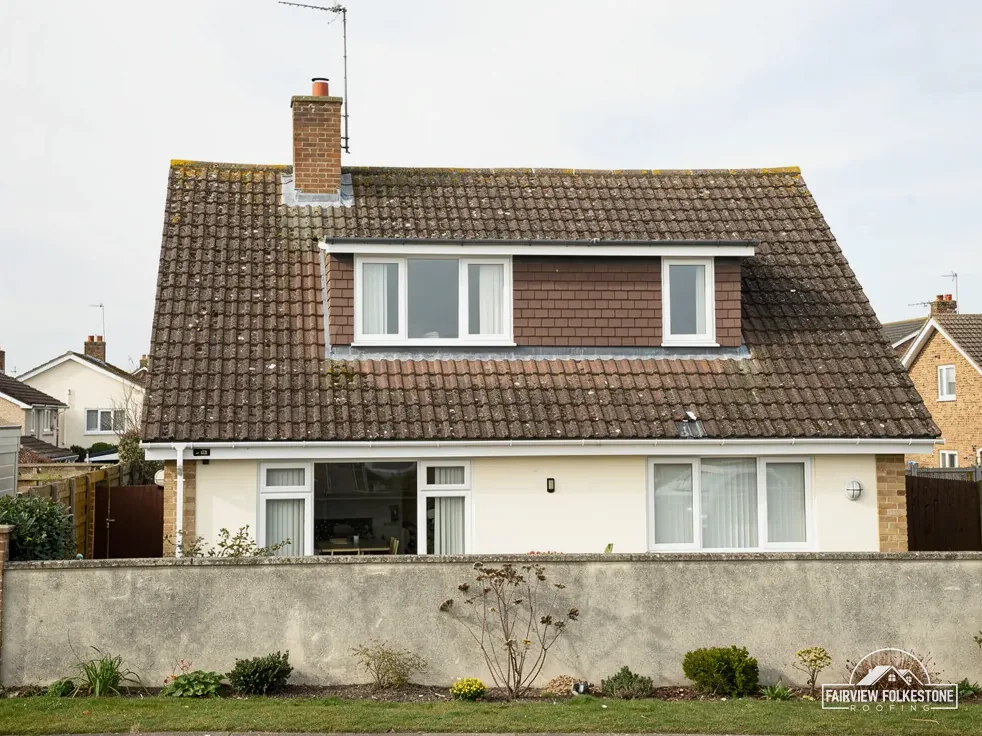
A house and its roof do not always share a birthday. Roofs are re-covered, patched, extended and altered, so the year a house went up tells you less than the year someone last worked on the roof above it. That is why a survey starts from what is physically there, and why we treat a street's age as a prompt and never as an answer.
Age still matters, because particular dates mark changes in rules, standards and products. A roof laid or refurbished before 2000 raises an asbestos question. A ridge bedded before the 2015 amendments to BS 5534 may rest on mortar alone. A house that is listed, or that stands in a conservation area, plays by different planning rules whatever it is built from.
This guide takes those age questions in turn, with the sourced figures that go with each. It does not say what any town is made of. What settles a roof is the survey of that roof, and the written price follows from it. Our roofing services page sets out how that works.
01Key points
Why the date of the last roof work matters most
When we look at an older house, we ask four things before we look at the tiles. Each one changes what the survey is checking.
- When was the house built, as far as you know?
- When was the roof last re-covered, and was it the whole roof or one slope?
- Has the house been extended, with a new roof meeting the old one?
- Is the house listed, or inside a conservation area?
The second question carries the most weight. A slope re-covered in one decade may sit beside a slope that is decades older, with a different covering, different fixings and a different remaining life. Lifespans are typical ranges and not promises, so we read each slope on its own evidence: the state of the battens, the nails or clips, the underlay and the lead.
Receipts, building control certificates and old photographs all help to date earlier work. Without them, the loft can tell us plenty. Dry, sound timber under an intact underlay points one way, and stained or soft timber points the other. If the hatch is missing or the loft is boarded out, we describe what the outside shows and say how far that limits the verdict.
Extensions deserve a particular look, because the join between an older roof and a newer one is where two ages meet. The lead dressed along that join may be a different age from either roof, and the fixings on each side may follow different standards.
Nothing here assumes a street is built of one thing. A single terrace can carry several coverings, because each owner re-roofed at a different time, and the survey treats every slope as its own case.
02Asbestos
Before 2000: the asbestos question
The Health and Safety Executive advises treating any building built or refurbished before 2000 as if asbestos is present, until a check shows otherwise. For a roof, that raises a question about sheet roofing, garage and outbuilding roofs, and soffit boards, and the answer changes how the work is done.
HSE's guidance on fragile roofs treats asbestos cement as fragile in every case, which is why no one stands on it. Its list of places where asbestos turns up includes white insulating board panels under the eaves, so a soffit on an older house is checked before any board is drilled or cut. Where there is doubt, the material is identified first and the plan for the roof is built around the result, instead of the other way round.
Waste has its own rules. Asbestos needs a lockable skip, and the open kind is out. The exemption from consignment notes for household hazardous waste excludes asbestos waste. A homeowner's own small amounts can go to a Kent household waste recycling centre, double wrapped, while a roofer's waste is trade waste. Our pages on garage and asbestos roofs cover that route.
| Material | HSE position | For the survey |
|---|---|---|
| Asbestos cement sheeting | Non-licensed work if carefully removed without breaking up | Never walked on |
| Cement sheeting broken or badly damaged | Notifiable non-licensed work | Stop and plan the removal |
| Asbestos insulating board soffits | Most work is licensed | Identify before touching |
Questions about house age
Do I need to know my roof's age before booking a survey?
No. We read the roof itself, from outside and from inside the loft when there is a way in, and the date is a prompt rather than a verdict. If you have invoices from earlier roof work, or know when an extension went on, have them to hand, because they date the parts of the roof that matter.
03Fixings · Ridges
Fixings and ridges: what changed in 2015
BS 5534 is the slating and tiling code, and BSI lists the 2014 edition with its 2018 amendment as current. Marley points out that installing to it is not required by law. Even so, the 2015 amendments settled one point: since then, mortar by itself has no longer counted as a dependable way to hold a roof covering in place.
That has a practical bearing on the age of a roof. A ridge, hip or verge fixed before those amendments may be held by mortar alone, and mortar cracks as a roof moves through the seasons. Dry-fix systems for ridge, hip and verge fall under BS 8612:2018, which BSI also lists as current, and they hold the tiles with a mechanical fixing instead.
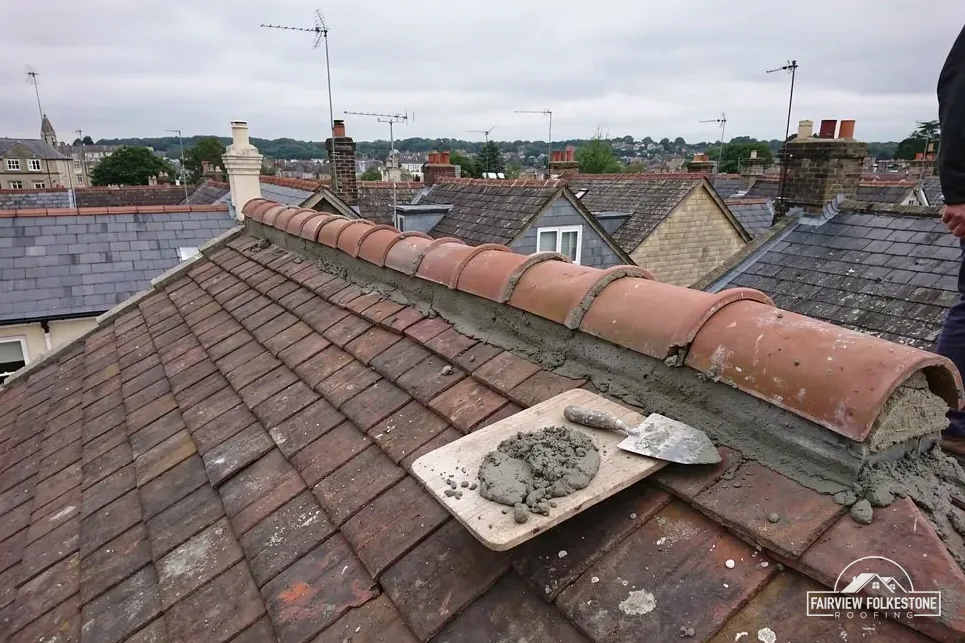
When we survey an older roof, we check:
- whether the ridge bedding has cracked, dropped or gone
- whether any ridge tile moves under a gentle push
- whether the verges carry mortar only, or a mechanical fixing as well
- how the tiles and slates themselves are fixed along the slope
Fixings are chosen for the roof's exposure. In Cupa's explanation, a building on a slope or hill, near the coast, or simply tall is rated for greater exposure, and BS 5534, as Marley describes it, contains wind uplift formulas for working out the fixings. A new covering's specification is therefore worked out for the house in question, not borrowed from the last roof we did.
Our answer on dry ridge or mortar bedding goes further into that choice.
04Tiles · Pitch
Tile type, pitch and why matching takes care
Every tile and slate has a lowest pitch it is made to work at, set by the maker. Pitch is the angle of the slope, and it is measured on site, with a level and a tape, before anything is ordered, because a tile laid on a slope flatter than its minimum can let weather in underneath.
Does a house built before 2000 have asbestos in its roof?
HSE advises assuming there is asbestos in a building built or refurbished before 2000. That covers the whole building and not only the roof, and assuming is not the same as finding it. A suspect material is identified before anyone disturbs it, and asbestos cement sheeting is never walked on.
| Tile | Material | Minimum pitch |
|---|---|---|
| Plain | Concrete | 35° |
| Double Roman | Concrete | 22.5° |
| Edgemere | Concrete | 17.5° |
| Canterbury | Clay | 40° |
| Lincoln pantile | Clay | 15° |
Canterbury in that table is a Marley product name, not the city. Natural slate has its own figure. Cupa reports that BS 5534 indicates a minimum pitch of 20 degrees for a project in a moderate exposure area using a 500mm slate with a 115mm overlap, and says hook fixings are not for pitches under 25 degrees.
Matching matters on an older roof where a slope is repaired and not replaced. A new tile has to match the profile and dimensions of its neighbours so the courses lock together, and it has to suit the pitch. A heavier substitute is a separate matter: a new covering weighing 15 per cent or more beyond the old one needs Building Regulations approval, and the Planning Portal's tip is to get a surveyor or structural engineer to check first.
For any tile in doubt, the maker's data sheet settles it, and we work from the sheet and not from memory of the range.
05Lifespans
How long each covering lasts, and where sources differ
Lifespans are typical ranges and never promises, and the published figures do not always agree. Where two sources differ, we name both and leave the choice between them to the roof in front of us.
Two cautions go with the table. The BRE minimum of 60 years belongs to clay tiles, which is why it sits in the clay row. And Marley is explicit that its own figure for roof tiles promises nothing about how long any given roof will last.
Lead has its own range. MyJobQuote says correctly installed lead flashing can last for over 80 years, which makes a flashing one of the longer-lived parts of a roof when it is fitted well. A roof well inside its range, with one local fault, is a repair. A roof near the end of its range, with trouble in several places, is where we start talking about re-covering the slope, and we set out what we found whichever way it goes, because the verdict depends on the evidence and not on a date.
Flat roofs on extensions follow the same reasoning with a different set of materials, and our flat roofing pages cover them.
| Covering | HomeBuilding (approx.) | Another source |
|---|---|---|
| Welsh slate | 100+ years | Not compared |
| Clay tiles | 60-80 years | Marley: a 60-year minimum, see below |
| Plain concrete tiles | 40-50 years | Marley: around 60 years, typically |
| EPDM flat roof | 25-30 years | Less: typically 30 to 50 years |
06Listed homes · Conservation areas
Listed, in a conservation area, or neither
A house's age can also place it in a protected group. Listed homes retain their permitted development rights for roof work, yet listed building consent is required too wherever the work alters the building's character. Conservation areas take dormers out of permitted development, and an Article 4 direction can withdraw further rights. Our planning guide sets the rules out in full, and the table below shows how many designations sit close to the centre of some towns we work in.
Can I choose a different tile for an older house?
Each tile has its own minimum pitch, and a covering weighing 15 per cent or more above the old needs Building Regulations approval, so the choice is made against the roof's pitch and loading. On a listed home, or in a conservation area, ask the council before anything is ordered, because the covering may be part of what is protected.
| Place | Conservation areas nearby | Listed example |
|---|---|---|
| Sandgate | 2, including Sandgate High Street | Sandgate Castle, Grade I |
| Hythe | 1 | Church of St Leonard, Grade I |
| Dover | 8 | Dover Castle, Grade I |
| Deal | 6, including Middle Street | Queen Anne House, Grade II* |
| Canterbury | 9 | Christchurch Cathedral, Grade I |
| Rye | 1 | Ypres Tower, Grade I |
The listings come from Historic England's National Heritage List. Whether your own address sits inside a conservation area, or under an Article 4 direction, is for the council to confirm. That means Folkestone & Hythe District Council for Folkestone, Hythe and Sandgate, Dover District Council for Dover and Deal, Canterbury City Council for Canterbury, and Rother District Council for Rye. A short call before work is planned saves a refused application later. Listing protects the building as a whole, so a job that looks like routine maintenance can still need consent when it changes the character of the roof. If the roof must be altered in any way, the conservation officer at the council is the first call to make.
More from the blog
All guides and posts
Tell us what's wrong with the roof.
You'll get one written total price.