
Replacement cost
How much does a commercial roof replacement cost?
Commercial roofs are priced after a survey, because the buildings differ too much for a rule of thumb. Below: what moves the total and what a quote should state.
The short answer
A commercial roof replacement can only be priced properly after a survey, because the range between one building and the next is wide. The area, the covering, the deck beneath, any asbestos, the access and the working hours each move the total. You receive a single written total, scaffold or access included. Treat any number quoted before someone has been on the roof as a guess.
4 min read · Part of Commercial roofing
Why a rule of thumb does not work
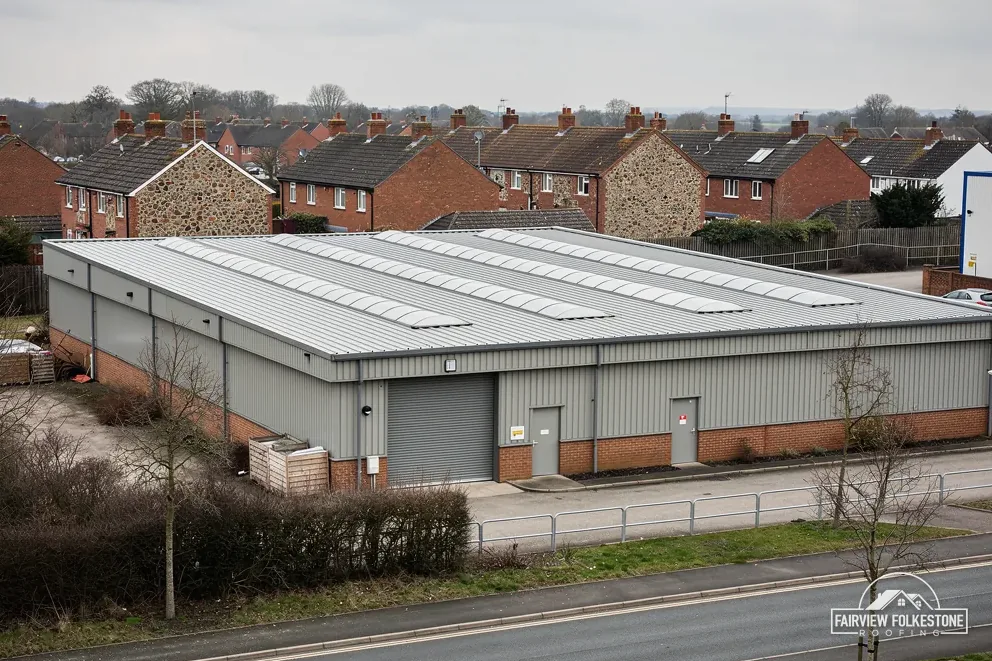
Cost guides on the web are written about houses, and a commercial roof is a different job. The area is larger, the covering and deck are different, the building is often occupied, and access can mean a mobile platform or a scaffold licensed on the public highway.
A figure per square metre hides all of that. It cannot see a deck that has gone soft, a flat roof with a fall that is wrong, insulation that has taken on water, a rooflight that needs fall protection around it, or cement sheets that must be treated as asbestos. Multiplying a rate by floor area gives a number that looks precise and has no basis in your building.
We do not publish commercial prices for the same reason. A figure given before a survey is a guess presented as an estimate, and it can move once the roof is open.
That is why the process runs the other way round, and why the survey is the first step on every commercial job. We look at the roof first, write down what we find, and price what the roof in front of us needs. The written price follows the survey and arrives as one total.
What moves the total
These are the findings that change the price, in the order the survey meets them.
- The area of the roof as measured, and its pitch or falls.
- The covering you choose, from single-ply to felt, GRP or metal.
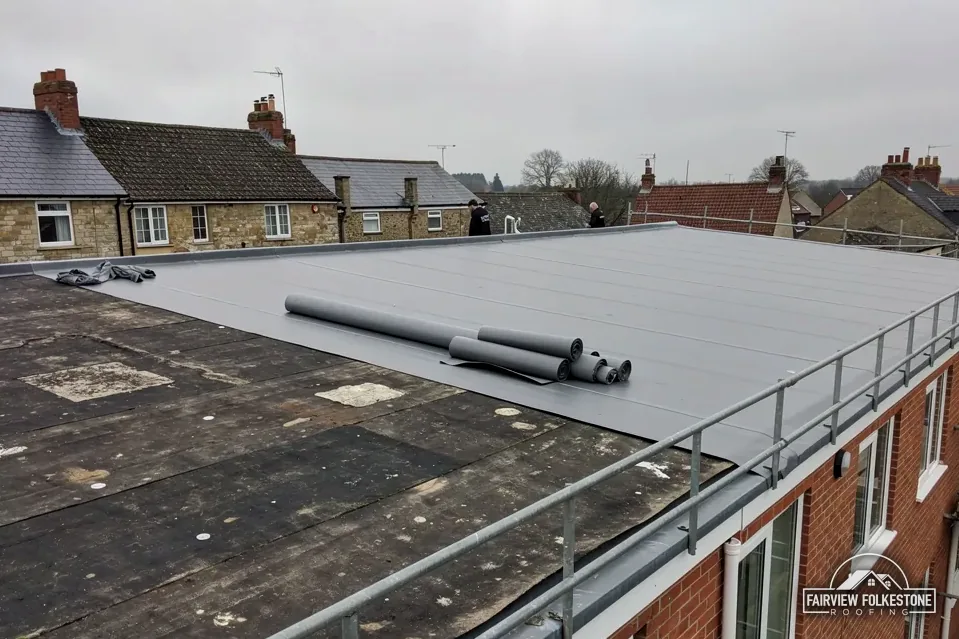
- The deck and the insulation. Wet insulation or a soft deck means a strip to the deck before anything new goes down.
- Asbestos. Cement sheets need a survey, careful removal, a lockable skip and a consignment note for the waste.
- Details: upstands, outlets, edge trims, rooflights and plant.
- Access and hours. Work beside a public pavement, or on a roof that must be dry by morning, takes planning.
- The state of the drainage, including whether outlets and box gutters need relining.
- Building Regulations. A re-roof can need an application, and a heavier covering is checked by a structural engineer first.
Scaffold is included in the written quote. If it has to stand beside the road or pavement, the licence comes from the highway authority for your county, and we arrange the licence with our scaffolder, so you do not chase it yourself.
What a written quote should state
Whoever you ask, a price you can compare says the same few things.
- The covering named, with the system and its thickness where that applies.
- What happens to the old roof: stripped, repaired or recovered, and why.
- Whether VAT and scaffold or access are included.
- How asbestos is handled, if the survey found it or presumed it.
- Who arranges the Building Regulations and highways paperwork.
- How the building stays weathertight while the roof is open.
Ask each firm to price the same specification, because quotes for different roofs cannot be compared on the total alone. A low figure that leaves out the strip, the scaffold or the asbestos is incomplete, not cheap. Ask also for the survey findings to be attached, so that each part of the specification can be traced back to something found on the roof.
Read the VAT statement in its own right, and the payment terms with it: when stage payments fall due, and what each is tied to. Two quotes with the same headline figure are not alike if one adds VAT on top and the other already holds it.
Getting to a price
The route is short. We survey the roof and write down the covering, the falls, the wet areas and anything that looks like asbestos. We then tell you whether a repair, a recover or a full replacement is the right verdict, and why. The price follows, in writing, as one total.
On a building let to tenants, or a block of flats with leaseholders, a major works price can also set off a consultation. Our guide on Section 20 roof works covers how that process affects the timing of a quote.
If you want to understand the survey before you book one, our answer on what a commercial roof condition survey covers lists what we look at. For the roof types we price, see commercial roofing.
You can also send a few photos of the roof and a note of the area it covers on WhatsApp, and we will tell you which route looks likely before the survey is booked. It will not be a price, but it saves a wasted visit and tells you what to have ready, such as access arrangements and any earlier surveys.
More questions
Can you give a rough figure per square metre?
No, because a rate per square metre ignores the deck, the access, the asbestos position and the details, and those decide the total. The figure we give is one written price after we have been on the roof, so it reflects the building in front of us, not an average.
Is the price fixed once the roof is open?
The written price covers the survey findings and the specification agreed. If the opened roof shows something the survey could not see, such as a deck worse than it looked, we tell you before going further and agree any change in writing rather than adding it to a bill.
More on commercial roofing
All guides and posts
Tell us what's wrong with the roof.
You'll get one written total price.