
Roof coatings
Do liquid coatings work on industrial roofs?
A liquid coating is a new skin over the existing roof, so it suits some and fails on others. Below: where it holds, where it fails, and what to ask.
The short answer
Yes, on a roof that is sound underneath, and no on one that is not. A liquid coating renews the surface and the seal, but it cannot dry wet insulation, tighten loose fixings or restore steel that has rusted through. It also leaves an asbestos cement roof as fragile as it was. The survey decides whether a coating is a fair repair or a cover for a fault.
4 min read · Part of Commercial roofing
What a coating does and does not do
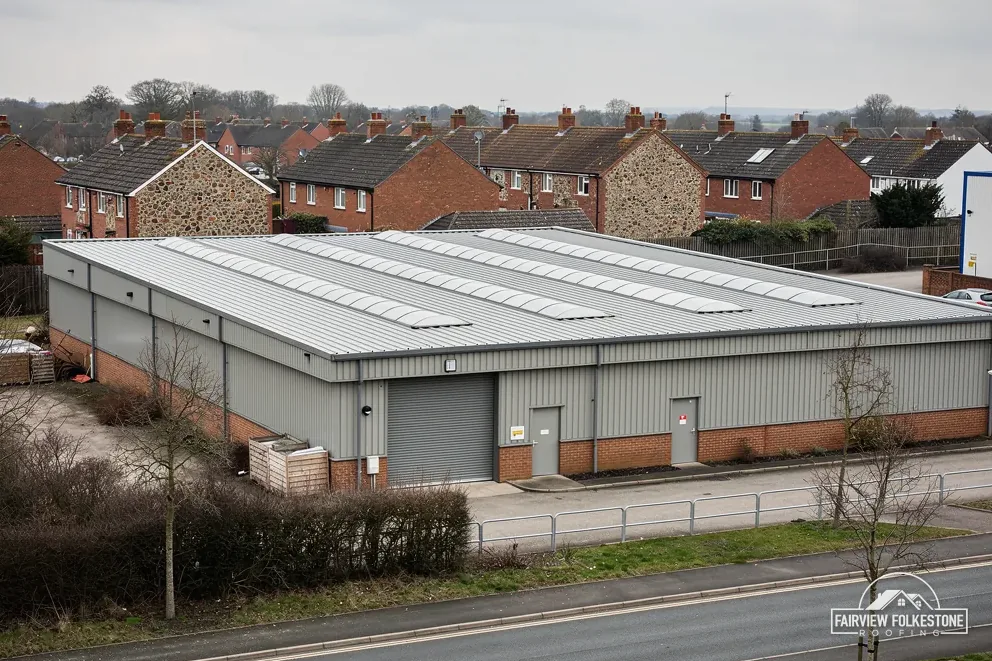
A liquid coating is applied over the existing roof and cures into a continuous layer. It can seal small defects, cover worn paint or weathered surfaces and close up laps and fixings, so it is a refurbishment tool, not a new roof.
That means it only works as well as the roof under it. A coating holds to a clean, dry, sound surface, and it cannot do the jobs of the other layers in the build-up.
- It does not dry insulation that has taken in water.
- It does not draw a sagging deck back to level.
- It does not add fall where water ponds.
- It does not hold a screw that is working loose in a rusted sheet.
A coating laid over any of these faults hides them for a while, and the leak or the corrosion carries on beneath it. That is why we test the roof before a coating is discussed at all, and why the survey comes before the product is chosen.
Ask the supplier for the maker's data sheet and read which surfaces and conditions the product is rated for. Roofers check pitches against the data sheet in the same way, and it is the document to rely on, not a sales summary.
Where a coating suits a roof
The roofs where a coating makes sense share a few traits. They are dry, structurally sound, and tired at the surface rather than failed.
| Condition of the roof | Coating |
|---|---|
| Sound sheets, dry insulation, worn surface and tired laps | Worth pricing |
| Rust through at cut edges or fixings | Repair the steel first |
| Wet insulation or a soft deck | Not suitable |
| Ponding from poor falls | Falls first |
On profiled metal, cut-edge corrosion is the fault to find early. Where the rust sits on the surface of an edge, the steel can be brushed back, primed and sealed before a coating goes over it. Where the steel has rusted through, those sheets are replaced. Our guide on cut-edge corrosion on metal roof sheets shows how to tell the two apart.
A coating also needs a safe way to apply it, and a dry spell to cure in. Any roof with fragile sheets or rooflights needs boards, platforms and edge protection for the crew, which is part of the work and part of the price.
Asbestos cement sheets and coatings
Many industrial roofs are cement sheet, and a building built or refurbished before 2000 is presumed by HSE to contain asbestos. A coating on that kind of roof raises questions the survey has to answer first.
HSE's A14 guidance puts asbestos cement roofs down as fragile in every case, so access for a coating crew is a fall risk before it is anything else. Cement sheets that are weathered, yet not seriously damaged, can be taken off as non-licensed work provided they are not broken up. Sheets that have been badly damaged or broken up move into notifiable non-licensed work.
Preparing a surface for coating can mean cleaning, scraping or refixing, and each of those can disturb sheets that have already weathered. That is the reason to settle the asbestos position before a product is chosen, not after.
Our answer on an asbestos cement roof on a commercial building sets out the categories. We do not recommend coating cement sheets until the survey has said what they are and what state they are in.
Questions to ask before you agree
Whoever proposes a coating, put these questions to them in writing and keep the answers.
- What did the survey find under the surface: dry insulation, a sound deck, rust at the edges?
- What preparation is planned, and how does it avoid disturbing sheets that may be asbestos?
- Which maker's system is it, and which data sheet covers this surface?
- What happens at the laps, fixings, rooflights and upstands?
- If a coated sheet fails later, what is the repair, and who carries it out?
A coating can be a fair answer on the right roof and a poor one on the wrong roof. We tell you which yours is after the survey, including when the answer is that a coating would only postpone a replacement, and what that postponement would be worth. You get one written total price once the survey is done, and it names the coating system, the preparation and the access.
For how a coating compares with recovering or stripping the roof, see our answer on refurbishing or replacing a commercial roof. The full list of roof types is on our commercial roofing page.
More questions
Will a coating stop a roof leaking at the laps?
It can seal laps and fixings that are sound but tired. It will not stop a leak whose cause is a loose fixing, a split sheet or wet insulation. The survey traces the leak to its source first, then says whether coating, repair or replacement fits the roof in front of us.
Can a coating go over an old cement sheet roof?
That depends on the sheets, and the first question is whether they contain asbestos. Cement sheets are fragile in every case, and preparing the surface can disturb them. We settle the asbestos position by survey before we say anything about coating them, and tell you what we found.
More on commercial roofing
All guides and posts
Tell us what's wrong with the roof.
You'll get one written total price.