
Timing
How long does spray foam removal take?
No single number fits every loft, because the foam, the route and the roof all change it. Below: what sets the length, and the waiting periods before work begins.
The short answer
It depends on the roof, so the number of working days is fixed in writing after the survey, not guessed from a phone call. A thin skim of foam between rafters, cut away from the loft side, is a shorter job than thick foam bonded to the tiles, where the covering has to come off and go back. Area, thickness, route and any timber repairs set the pace, and notice periods before the start can add days too.
5 min read · Part of Spray foam removal

What stretches a foam removal job
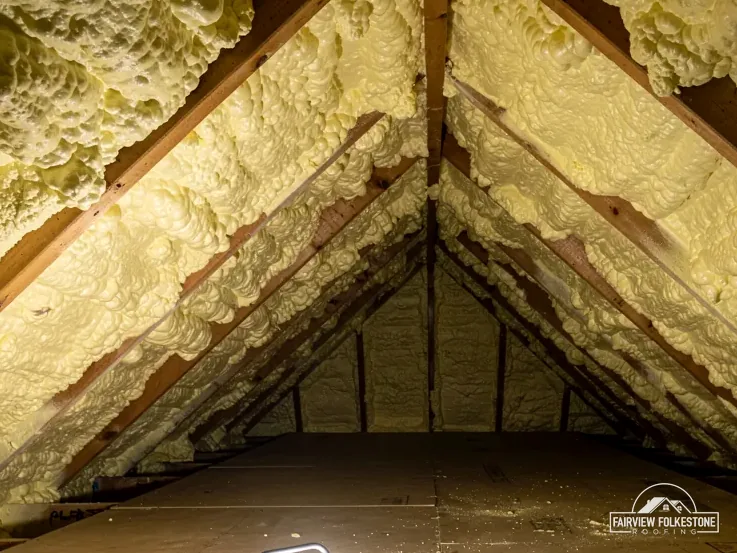
Spray foam cannot be lifted out in sheets, so the pace is set by how stubbornly it holds on and how much of it there is. The factors that matter most are these:
- The area sprayed, which may be one slope or the whole roof.
- The thickness of the foam, because thick layers are cut in smaller pieces and take longer to clear.
- What the foam is stuck to: whole felt, failing felt, or the backs of the tiles.
- Whether it covers the rafters or stops short of them.
- Room to work in the loft, and how far everything is carried to the skip.
- Timber repairs found once the rafters are bare.
None of these can be read from outside the house, which is why a figure quoted without a visit means little. We would rather give you a number we can keep to than a short one that slips, and the survey is where that number comes from: the test area, the readings and a look at the access all go into it.
The waiting periods before work starts
Some of the delay comes before anyone picks up a tool, and several of the periods are fixed by rule rather than by us.
| Step | Period | Applies when |
|---|---|---|
| Cancellation period | 14 days | You sign at home after the survey |
| Kent scaffold licence | Applications 5 working days ahead | Scaffold stands on a Kent pavement |
| East Sussex extension | 5 working days before expiry | A Rye or Camber licence must run longer |
A contract signed at your home carries the 14-day cancellation period, and a start inside it needs a written request from you. Kent County Council asks for licence applications, renewals included, at least five working days before the start date, and East Sussex Highways asks for extensions five working days before expiry. We arrange the licence with our scaffolder, so the notice period is built into the plan, not left for you to chase. Loft-side work needs no scaffold, so for that route the scaffold rows do not apply. The 14 days still do whenever the contract is signed at home, and they are the one wait that never changes with the route.
How the route changes the working days
The route chosen after the test area has a large bearing on how long the roof is under repair. Cutting foam from the loft side leaves the covering in place, so there is no scaffold to erect and no tiles to lift, stack and relay. Opening the roof from above adds those steps, along with new felt and battens where needed, and the weather matters far more because the roof is exposed.
The test area itself is quick, but it can change the plan. Foam that peels clear of sound felt keeps the job on the loft route. Felt that tears with it moves the job to the longer route, and the written total and the expected days change together, with the photographs that explain why. Wet or soft timber adds days of its own, for the repairs and the drying they may need, and those days cannot be counted until the foam is off and the wood can be read.
Our guide to how spray foam is removed compares the two routes, and the question of removing foam without lifting the tiles has its own answer.
What happens after the foam is out
Clearing the foam is not the end of the programme. Once the rafters are bare, the timber is read with a moisture meter and probed for soft patches, and any repairs are done before anything covers it again. Then the roof is put back: new felt where it is needed, ventilation at the eaves, and insulation again, laid so that the roof can dry.
That second half can take as long as the first, which is why a quote that mentions only the foam coming out should be questioned. Ask any roofer whether the time and the price include re-felting, ventilation and insulation, and whether the site is swept at the end. Ours do, and the guide to what happens after spray foam removal sets out the order.
Ask for the working days in writing, and ask what happens to them if the weather turns or the test area changes the route, so that a revised date reaches you before the day, not after it. The overall service, with the survey that starts it, is on the spray foam removal page.
More questions
Can the foam come out on the day of the survey?
No. The survey, the written total and the cancellation period for a contract signed at home all come first, and an earlier start needs your written request. Where scaffold is part of the route, its licence adds a notice of its own. A rushed start would also skip the test area that settles the route, and that is the step that protects the felt.
Does bad weather stretch a foam removal job?
It matters most on the route that opens the roof from above, because the felt and battens are exposed until the tiles are back. Work is planned in stages that can be sealed before dark, and a stage is left covered rather than rushed if rain is forecast. Loft-side cutting is far less affected.
Tell us what's wrong with the roof.
You'll get one written total price.