
Loft route
Can spray foam be removed without lifting the roof tiles?
Whether the tiles can stay put turns on the layer the foam grips, which only the loft can show. Below: the conditions, the warning signs and the rules.
The short answer
Yes, where the foam sits on sound felt or only fills the gaps between the rafters, because it can then be cut and scraped from inside the roof space with the covering left in place. It cannot where the foam has bonded to the tile backs or pulled the felt apart, since the covering must then come off. A test patch in the loft shows which case your roof is.
5 min read · Part of Spray foam removal

When the loft route is open
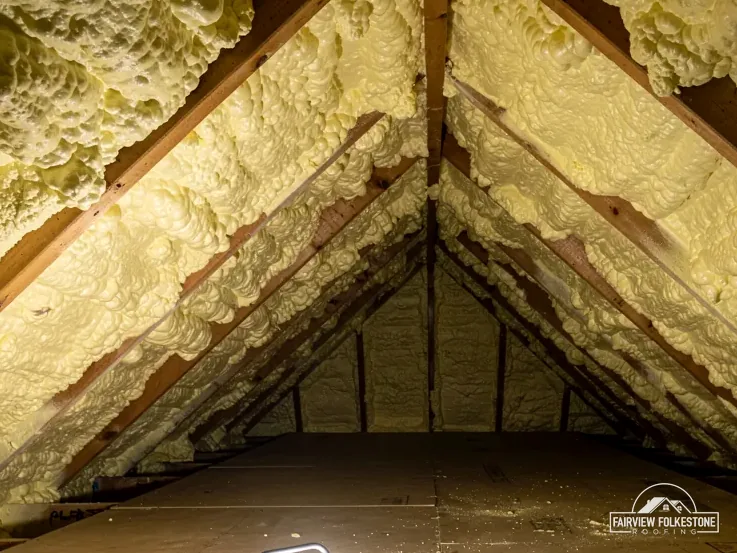
The loft route works when the foam can be parted from its backing without harming it, and nothing outside needs disturbing. Both points are judged from inside the roof space, with a torch and a test patch, not from the garden.
- The foam sits on felt that stays whole when a patch is lifted.
- It fills the gaps between rafters, or lies over them in a layer thin enough to cut in pieces.
- The battens and the backs of the tiles are clean, with no foam bonded to them.
- The timber under the foam is dry and firm when probed.
Cutting is done in small pieces by hand, one bay at a time. The pieces are bagged and carried out so that dust and lumps do not drop onto the ceilings below. No scaffold goes up, so there is no highway licence to arrange. Spray foam sets hard and is meant to stay put, and the loft route shows what that means: slow, careful work, not a quick pull. Because the ceilings below are protected and the pieces are small, a thick layer takes noticeably longer to clear than a thin one, and the survey says which of the two you have.
Signs the tiles will have to come off
Some results close the loft route at once. The table shows how the common ones read, and each can be seen only once the test patch is open.
| Test patch shows | Route | Reason |
|---|---|---|
| Foam lifts clear of whole felt | Loft | Felt can stay |
| Felt tears with the foam | Above | New felt needed |
| Foam bonded to tile backs | Above | Cannot be reached |
| Foam fixed hard to battens | Above | Battens may split |
The RICS consumer guide gives a warning that applies here: with spray foam over the roof timbers, they are only partly visible, which is why a patch is opened before any promise is made. When the result moves the job to the second route, the written total changes with it, and you are shown the photographs that explain why before work goes on. Nothing is forced: a patch that fights back is a result, and it is recorded as one, with its place noted on the roof plan so that the next step is plain to follow. Our answer on whether removal damages the roof covers the risks to felt and tiles in more detail.
What staying on the roof does to the rules
Cutting foam from the loft leaves the covering as it is, so the re-roofing tests are not engaged by that route. When a job does move to the roof above and the covering is renewed, the Planning Portal's guide says no building regulations application is normally needed while the re-roof affects under 25 per cent of the building envelope and under 50 per cent of the roof.
The insulation that replaces the foam is a separate matter. Part L covers energy saving, and Table 4.3 in AD L 2021 gives two roof figures: a threshold of 0.35 W/m²K for an existing roof and an improved value of 0.16 W/m²K. The standard asks a renovated roof to reach the improved value if that proves workable and worth its cost, so the new insulation can matter even when no tile is lifted.
Dover-district addresses also follow Dover District Council's own list of work needing approval. For any address, ask building control before the new layer goes in, and keep what they say in writing. Councils word their guidance differently, so the answer is theirs to give.
Questions to put to a roofer who offers it
A promise that the tiles will stay untouched is worth having only if the roofer can also answer these.
- If the felt tears mid-job, who decides the change of route, and how is the new total shown to you?
- Are new insulation and eaves ventilation inside the written total?
- Have the old soffit boards and any sheet material been identified before anyone cuts near the eaves? HSE advises assuming asbestos in a building built or refurbished before 2000.
- What is the plan if a bat roost or a nest in use is found, and who stops the work? Roof work can disturb bats, and GOV.UK treats their roosts as fully protected by law.
- Is there one total price in writing, and does it state what is included, such as VAT and any scaffold?
Ask for the answers on paper, because a spoken reassurance cannot be checked later. Our guide to how spray foam is removed follows both routes step by step, and the spray foam survey answer shows what is looked at first. The wider spray foam removal service begins there.
More questions
Is removing foam from the loft side cheaper?
It avoids the scaffold, the lifting of tiles and the relaying, so it is the lighter job where the roof allows it. The price is still one written total, fixed after the survey, and it moves if the test patch sends the work to the roof above. Nobody can say in advance without seeing the foam.
Can I check the felt myself before a survey?
You can look at it from the hatch with a torch, but foam hides most of the felt and the timber, so what you see is partial. Do not scrape at it. Take photographs of the whole loft and of any dark patches, and pass them on with the survey request.
Tell us what's wrong with the roof.
You'll get one written total price.